
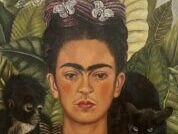
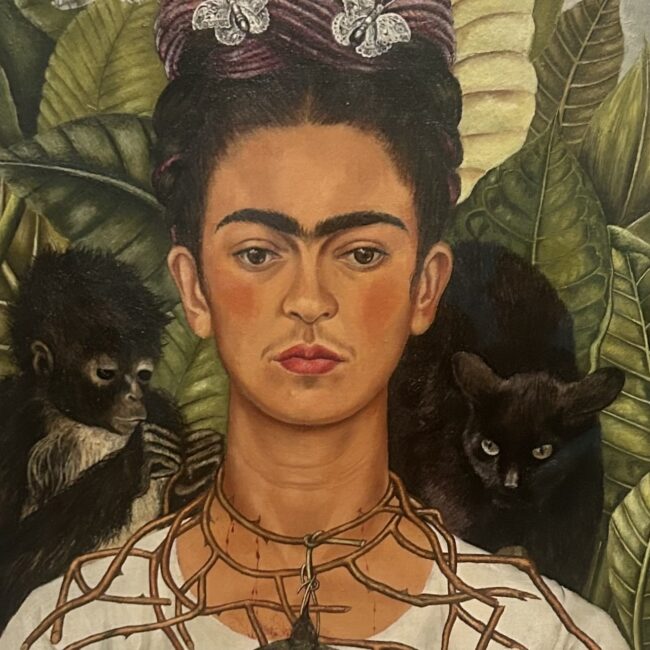
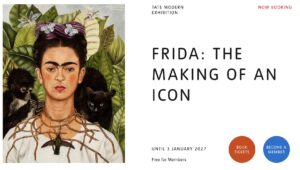
Putting on a show of Frida Kahlo´s work in a large gallery space is never going to be easy. The legendary artist only ever created about 200 works of art, mainly small or medium-sized, most of which are in the hands of private collectors or museums unwilling to lend them for shows. The public, however, has an enduring obsession with her, so how to fulfill that? The Tate´s answer is to present Frida: The Making of an Icon, a show which examines the influence of the work of Kahlo´s peers and contemporaries on her work as well as her own influence on other artists´ work. The result is a beautiful introduction to some excellent other artists from her era but also potentially a dilution of her legacy with the inclusion of later, much lesser, ´inspired by´ works, and even a room of random Frida Kahlo gift shop-style merchandise.
Born in Mexico City in 1907, Kahlo was a painter known for her portraits, especially her self-portraits, and her folk art-inspired style that explored gender, sexuality, post-colonialism, class and race. Major injuries sustained during a traffic accident at age eighteen plagued her for the rest of her life and heavily inspired her work. She’s also known for her surrealism, although she always rejected any such label. Her 1940 self-portrait titled The Dream – The Bed holds the record for the most expensive painting by a woman ever sold, at $54m.
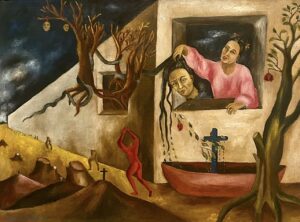
The show contains about 30 original Kahlo works, beginning with her earliest paintings, which are shown alongside those of her contemporaries as well as personal possessions of hers, including dresses and jewellery. Her work reflects her multi-layered identity. She was simultaneously an avant-garde artist, an intellectual, a political activist, a wife, bisexual, and disabled. Rules and conventions were challenged and broken if necessary. Kahlo was in a long-term relationship with fellow artist Diego Rivera and had to fight as a woman artist to be seen outside his shadow. She was part of an intellectual group of creatives who included Abraham Angel and Rodriguez Lozano. They fed off each other, relishing Mexico´s rapidly modernising society.
We move on to a beautiful section of surrealism. The French Surrealists of the 1930s felt she was one of them, but she rejected the notion, arguing that she represented her reality rather than dreams. Nevertheless, there are similarities, especially with her recurring themes of death, dreams and masks. We can then see some of Kahlo´s works from her late 1930s shows in New York and Paris when she began to earn recognition from fellow artists such as Picasso and Marcel Duchamp. Another string to her bow was her reinvention of still life painting, often from a surrealist bent. The next section displays some beautiful examples of this work, also reflecting her love of nature.
Kahlo died in 1954 aged 47. She and her work didn’t become famous until the 1970s, twenty years after her death. At this point her imagery and style were adopted by US human rights activists advocating for better rights for Mexican Americans. Some of their campaign imagery forms the next section of the show.
Gender and sexuality were prime themes in Kahlo´s work. She often depicted herself with a moustache and a uni-brow, and sometimes in masculine clothes with cropped hair. She became a feminist icon, particularly from the 1970s onwards.
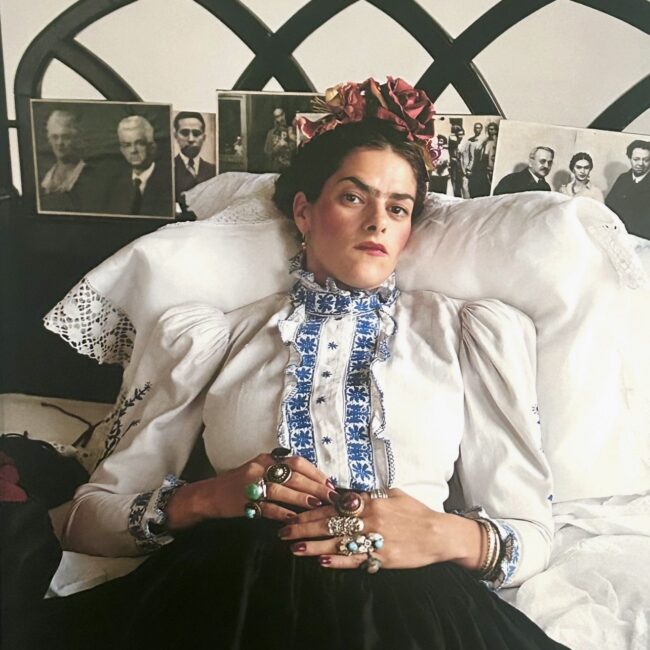
We then move on to a section of more recent work by artists inspired by Kahlo – a gem here is photographer Mary McCartney’s fabulous shoot of Tracey Emin dressed as Kahlo – before culminating in a random room full of Frida Kahlo-inspired gift shop merchandise. This room is sure to divide the audience, and I for one skipped through it asap.
Overall, however, this is a strong show just for placing Kahlo in the wider context of her contemporaries. As a result, it’s less about her personal life – her complex relationship with fellow artist Diego Rivera is barely touched upon, nor is her personal health, which completely defined her life. Some fans of Kahlo may feel cheated, but gem after gem of the work of her contemporaries from the 1930s should make up for that. It´s a very busy show, so try to visit at off-peak times. 
 |
|
RIS FATAH SENIOR CONTRIBUTING EDITOR London & Ibiza Queerguru Contributing Editor Ris Fatah is a successful fashion/luxury business consultant (when he can be bothered) who divides and wastes his time between London and Ibiza. He is a lover of all things queer, feminist, and human rights in general. |

Comments
One response to “Queerguru´s Ris Fatah reviews ‘Frida: The Making of an Icon’, a detailed study of the legendary artist, Frida Kahlo.”
[…] Coinciding with the public opening of Frida: The Making of an Icon at Tate Modern (see our review HERE) ¡Frida Icónica! has taken over Carnaby Street, transforming the cultural hub into a vivid […]