
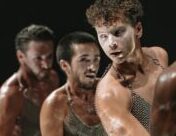
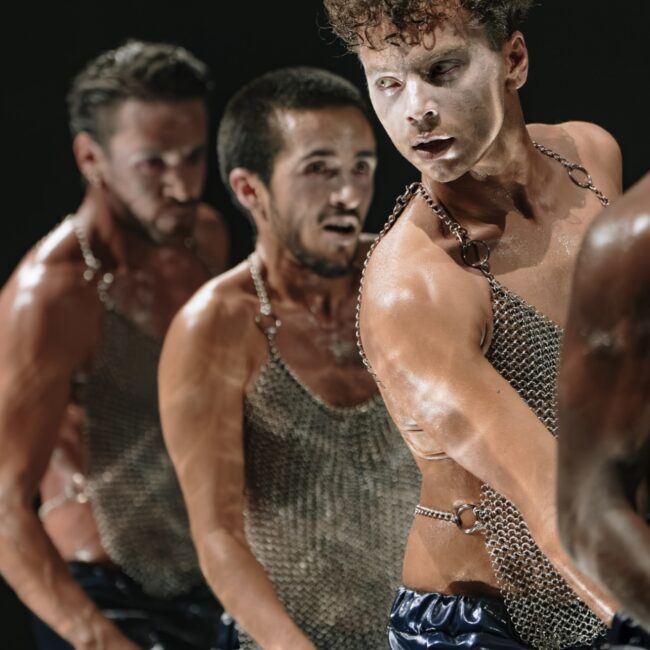
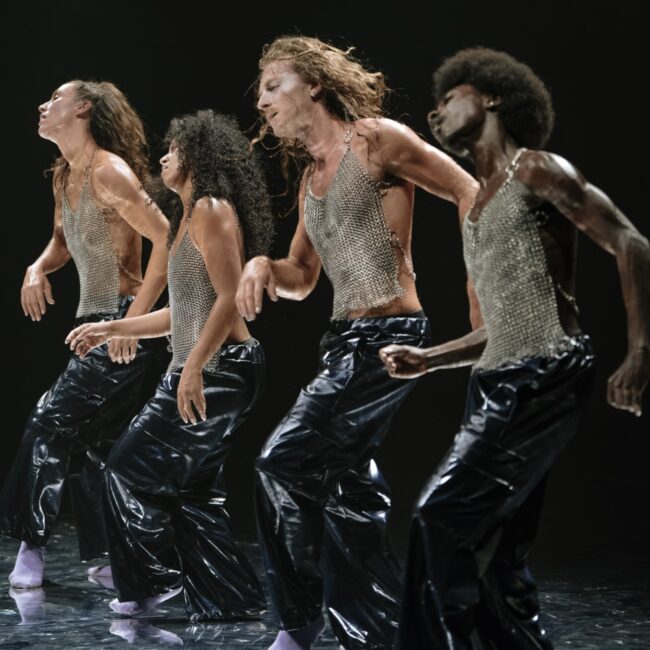
Portuguese choreographer Marco da Silva Ferreira returns to London´s Sadler’s Wells East this 4-6th June with the UK premiere of F*cking Future. The genre-crossing work examines over-militarisation and toxic masculinity in contemporary society, challenging the patriarchal systems of power that shape bodies and behaviour. Drawing parallels between military and militant bodies, it blends house and techno aesthetics with contemporary dance styles to create a high-energy, physically demanding piece that echoes resistance and revolution.
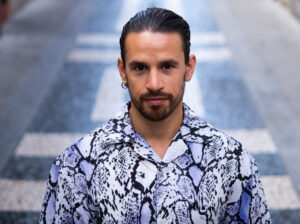 Set within a vast yet intimate quadri-frontal stage – part fight ring, part kiosk, part museum – Ferreira is joined by seven dancers who shift between rigidity and fluidity, discipline and desire. Blending military rigour with the freedom of club culture, F*cking Future uses collective movement to explore new forms of union and insurgency. Before heading to London, F*cking Future will be also shown at Theatre National de Chaillot, Paris from the 27 – 30 May.
Marco is on a roll at the moment – last year his highly-celebrated work CARCAÇA was shortlisted for the first edition of Sadler’s Wells´ Rose International Dance Prize, and this year he has been awarded the CHANEL Next Prize, joining a group of ten international artists recognised for the innovation and cultural impact of their work. This show is therefore a hot ticket!
I caught up with Marco during rehearsals to find out more.
Your new work, F*cking Future, sounds very relevant for now. What inspired you to create this piece?
Very often, my works emerge from places of personal discomfort that I then try to connect with a collective resonance. In this particular case, it was the force of the systems in which I grew up that shaped a certain performativity related to masculinity, productivity, formal, emotional and psychological discipline.
More recently, the semantic presence of militarisation, security forces, control, and similar ideas has also heightened questions connected to the past and the ways it has been shaped along this path. Bringing together militarisation and activism/militancy opened up an interesting reflection on the choreography of bodies, on the panopticon, but also on dance itself- on the power of collective organisation through ways of thinking that diverge from the norm.
How would you describe your choreography to someone who hasn’t seen one of your shows before?
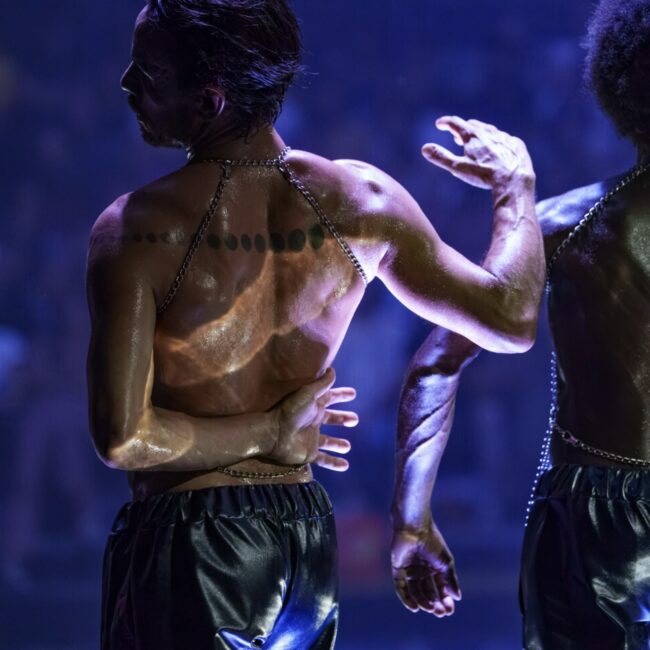
It is a collective body of work, where there is a choral voice, a shared body. The choreography brings together different dance styles, spanning street dance and club cultures, while also embracing a gestural language and a sensitivity towards abstract expressionist movement.
The works are usually highly kinaesthetic and often reflect on collective identity, heritage, and culture.
Your career is currently on a roll – with last year’s Carcaça shortlisted for the Rose International Dance Prize, and your 2026 award as one of the winners of the CHANEL Next Prize. How will winning the CHANEL prize change things for you?
It is an honour to be recognised for 13 years of work and 13 creations with this distinction from CHANEL.
It clearly marks the end of one cycle and opens another, which I am still in the process of discovering. It will allow me to work with greater calm and motivation in the coming years, helping me to build stronger structures and better ways of making art from Portugal.
Tell us about the new Sadler’s Wells East space. Most of us haven’t been there yet.
I visited the space last year during its opening week, and I was astonished. It is an important structure not only because of what it enables, but also because of what it symbolises at this moment in time.
Investment in the arts, in the performing arts in particular, is fundamental. We are becoming increasingly distant from one another physically. We are losing places of encounter, rituals of presence, an awareness of bodies and their materiality. Theatre, and the act of gathering in a theatre, are essential in creating moments of face-to-face exchange, eye to eye.
What career advice do you have for any dancer wishing to turn professional?
It is always difficult to give general advice that feels meaningful for so many dancers working across very different areas. But perhaps there are three things that I feel are consistently important.
The first is curiosity and a willingness to know more, to know differently. The second is the search for routines and practices that are both physically diverse and psychologically healthy, aligning both is essential. The third is to surround yourself with people who make artistic sense to you. If artistic families can exist, ask yourself: which groups, collectives, or communities excite you and that you would love to be part of?
Thanks Marco! Sounds great. I’m really looking forward to this show
|
More information and tickets https://www.sadlerswells.com/whats-on/marco-da-silva-ferreira-fcking-future/ |
| Queerguru’s Senior Contributing Editor Ris Fatah is a successful fashion/luxury business consultant (when he can be bothered) who divides and wastes his time between London and Ibiza. He is a lover of all things queer, feminist, and human rights in general. @ris.fatah |
