
QG: So, how much is fact and how much is it his imagination?
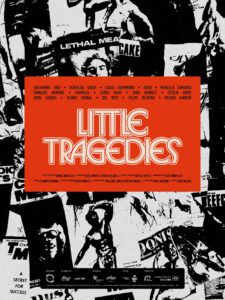 DN: So, the project originally started as a documentary, but as soon as I started working on the screenplay, I realized I couldn’t tell everything I wanted to with facts alone. So I started reimagining the stories and adding a lot of fiction to the film, and that is when it became a hybrid format. So, all the stories are true stories; they’re all based in reality, but they’re somehow reimagined and fictionalized, and nowadays I call it, and say the film is a fiction film based on true facts.
QG: Reimagined or fantasized?
DN: So, I use the word fabula, which I’m not sure about; let me check out the good translation for it. Why did he want to share the story? Why was it important? Does that make sense? Fable?
During those four months in Catalão, I felt very lonely because I realized many of my friends who were part of the community had moved away, died, or were no longer there. And that’s when I realized that there was some sort of phenomenon happening with the queer community living in the city that forced queer people to move away. That phenomenon is what made me realize I had to shoot a film about this story.
QG: Okay. So, let’s get to something lighter. How did you choose a really great person to play you?
I actually met Guilherme during the shoot for Dry Wind. He did a test, and I really liked the test. He didn’t end up doing the film, but I told him about the next film we’re going to do together. And Guilherme has a certain sense of humor, which I think I have too. I think that led to his choice. I think he has a certain comical mood, which I think is very close to mine too.
QG: How real is your film? Is it that tough, as you made a portrait of how hard it is to be gay in a small town? Plus, how real is this beauty that you show in the film?
Even though we can’t escape reality. We don’t have this possibility of reimagining or rephrasing what happened, as we do in the film. So for me, reality is even tougher than what I portray in the movie, because for this film, I used many resources to actually reinvent and reimagine what actually happened to the characters.
For instance, I used the example of the relationship with Samuel, his best friend. In reality, Samuel died and they didn’t have the opportunity to actually reconnect and say everything that was left to be said. But I used this resource in the film to reimagine it when I created this last scene in the car, in which both of us see the sunrise and are able to actually say everything we were feeling, and that we were not able to say in real life.
And also with the story of Mona Lisa, when I gave her this epic musical number where she can show the world what happened to her and be this star for at least a moment, because in real life, she was to be buried with her birth name and male clothes. So when I gave her the opportunity to be this star, to be this sea goddess she wanted to be buried with, but her family didn’t allow her to get this chance, I reinvented reality and made it a more poetic and soft reality than the toughness.
QG: We all wish we could do. I was very interested to see that an actorhas been nominated for Best Actor in Wales, a very small community. Can you relate to that? I mean, the Iris Prize, it’s a powerful film festival, but it’s a very small community. Does that mean much to you?
DN: I think there is a universal link between LGBT people who live in cities in the interior, regardless of where they are, which is the question of the construction of cultural homophobia, which is closely linked to this patriarchal society, this bourgeoisie that exists in the West.I think there is this capacity for communication, even with places as distant as País de Gás. I think it’s very specific, but at the same time very universal.
Maybe the fact that Cardiff in Wales is also a small community connects with the film’s reality, which also portrays the queer community in a small town. So the things we face, the challenges we face to exist and to fight for our existence, they’re all the same wherever we are.
QG: I don’t quite understand. In our Facebook following, we have some 69K, but the biggest country they come from is Brazil, and I don’t quite understand why.It seems strange to me.
DN: We’re all about the internet in Brazil. Brazilians are really into the internet and social media; it’s a big thing for us.And the Brazilian queer community is very active on social media, on the internet, so we put a lot of ourselves into engaging in social media.
QG: It’s interesting to find. Good luck, great to talk to you, and it’s a great film. That’s three out of four we’ve seen. I hope it does well, and I hope that it wins that award in Wales.
DN: Thank you. It was nice to meet you.
| PS You can read Queerguru’s full review of Little Tragedies HERE |

Leave a Reply