

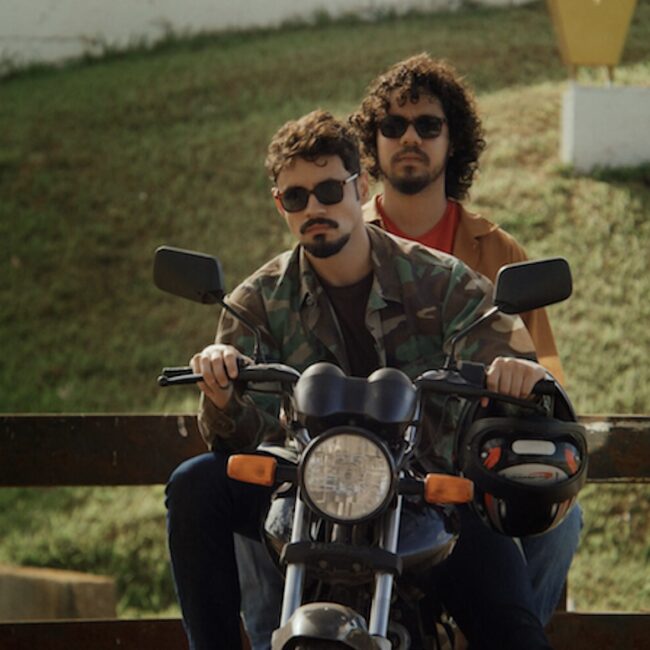
Homoerotic desire translates into powerful images and a witty narrative that leaves the viewer longing for more.
The autobiographical film is divided into a prologue, five chapters, an intermission, and an epilogue. A warning: this is not a happy film; a congenial one, sure, is.
Its author, writer, and director, Daniel Nolasco, recreates and shares his story and life in the small town of Catalão his city of birth, an industrial, mining, and agricultural hub in Goias state, midwestern Brazil. To do so, he develops colorful creative skills and shows them in a peculiar way. Hiring an actor (Guilherme Theo) to perform as himself, there is a narrator (Geovaldo Souza) who also gives voice to the director´s character; in their gentle and clever company, the storytelling flows while meeting family, acquaintances, and friends in the context of the city which is also portrayed in its culture and citizens.
 In a sequence in front of a TV, there is 10-year-old Daniel watching a program with his godmother, her husband, and cousin; the duality hetero-homosexual showed on the screen. He didn´t understand a thing, but his uncle’s baffled reaction. Daniel lived a quiet life in Catalao, in a house that is not there anymore, among his bad-blood hetero brother and his laconic mother, to whom, at 18, he came out… her answer was that it was ok but not to tell anybody, a bit late, since everybody already knew.
Through the film, we learn about sexual attraction, homophobia, solidarity, Brazil’s violent history against indigenous people, desire, passion, bullying in daily life activities, progress, modernity, and indifference. It even includes a Manual on how to live in small-town communities: dress code, cruising, and fetishes.
We are introduced to Monalisa (Aivan), a 59-year-old transvestite living by Dona Helena gas station, a place known by all but frequented by few. Monalisa, a sea goddess without a sea, lives in her small world. Her appearance in the film speaks to individual will against familiar choices. Her singing to the angel is deeply moving, calling a love so far.
The narrative flourishes and deepens with Samuel (Lucas Drummond), who tells us about a significant date: June 7th, 2012. We get to know about him and how he becomes the town´s gay standard and lives with HIV. Reality and fantasy intertwined, and friends say goodbye at sunset, when the sun refuses to leave, in a wink to Joshua Logan´s Picnic.
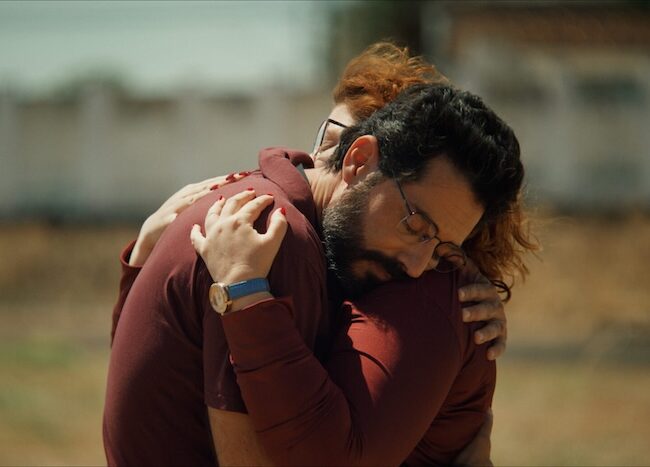
The epilogue shows constant change, urban plans, progress, development… and an overwhelming loneliness. After all, it was not a joy to live in Catalao.
The narrative mentions everyone’s zodiac sign. Eye-candy actors chosen to play the real-life people. The director revisits his hometown and, in his third fiction feature film, invites viewers into a complete immersion in his aesthetics and dynamics.
The film stands on its own among works of autofiction such as Almodóvar’s Pain and Glory – Bitter Christmas, Cuarón’s Roma and Fellini’s Amarcord, among others. 
|
JOSE MAYORGAS : CONTRIBUTING EDITOR. Guatemala, Central America Lawyer and notary public, visual artist, and editor of El Azar Cultural, lives and works in Guatemala City. Cinema lover, curious about the possibilities life brings and eager to live the experience. |

Comments
One response to “Queerguru’s Jose Mayorgas reviews LITTLE TRAGEDIES an enthralling autobiographical film by Daniel Nolasco”
[…] filmmakers (you can check out our past reviews of his work HERE). Now, with his latest movie Little Tragedies doing the film festival, we wanted to talk with him, especially when we discovered this one was […]