

 A Pele das Coisas (The Skin of Things), a solo exhibition by Brazilian artist Lucas Foletto Celinski, based in Berlin, opens on November 28, 2026, at 5 pm, at the Centro Cultural Banco do Nordeste (CCBNB) in Fortaleza, Brazil.
Curated by Eduardo Bruno, the exhibition presents a selection of works spanning more than 20 years of the artist’s practice, including textile works, photography, jewelry, and video. Through different materials and artistic approaches, Celinski explores the body as a space of transformation, examining its relationship with objects, materials, and the social structures that shape and define it. The exhibition marks the artist’s first solo presentation in Brazil.
Where does a body end? At the surface of the skin, at the limits of its anatomy, or in the relationships it establishes with what passes through it? The body and its boundaries are less stable than we assume. Formed through a series of contacts, inscriptions, tensions, and negotiations with the world, the body finds in the skin a surface of encounters and crossings, where what touches it also transforms it.
In A Pele das Coisas, the work of Lucas Foletto Celinski invites us to think of the body not as a unit enclosed within itself, but as a territory constantly shaped by material, social, and desiring forces.
Through photographs, sculptures, installations, screen prints, and performance records, the artist explores ways to subvert structures that seek to define the boundaries of bodies. Ropes, metals, fabrics, and binding devices form a material vocabulary that does not simply serve as accessories to an already existing body. Instead, they help shape it, producing other anatomies, reorganizing its contours, and creating possibilities for experimentation. The artist’s research thus approaches practices of body modification and experiences related to queer sexualities, moving objects and procedures associated with adornment, suspension, and bodily transformation into a language that does not seek to represent fixed identities. In this context, abstraction is not a departure from the political questions of the body, but a strategy to expand its possibilities of existence beyond the images and codes that seek to define it.
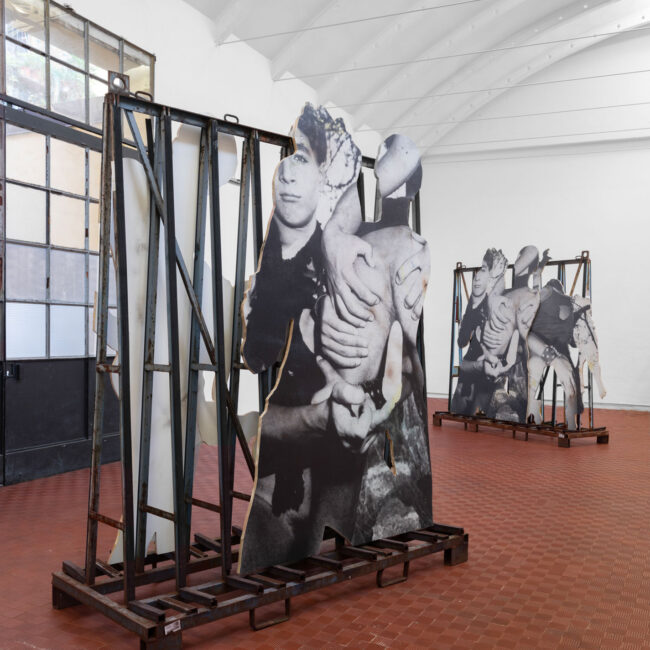
Another significant movement in his work is that the devices that initially establish direct relationships with the skin begin to exist independently of the physical presence of bodies. The objects thus preserve a kind of memory, as if they continued to perform gestures even after those who once activated them were gone. In the photographs and performance records, the image does not function only as documentation of a past action. It helps construct the artistic experience itself, extending the duration of gestures and allowing different temporalities to coexist. In this way, the body becomes a trace, while the objects remain open to other configurations and meanings.
To think about A Pele das Coisas, then, is to recognize that the boundaries between subject and object, body and space, matter and desire are constantly negotiated. The skin is no longer understood as a boundary separating inside from outside, but as a surface of encounters, crossings, and contaminations.
More than something that protects or defines limits, it is also what exposes us to the world and makes our transformation possible. After all, no body takes shape without what touches it, just as no things exist without carrying on their surfaces the marks and memories of the bodies that have passed through and transformed them.
| A Pele das Coisas (The Skin of Things), a solo exhibition by Brazilian artist Lucas Foletto Celinski, based in Berlin, opens on November 28, 2026, at 5 pm, at the Centro Cultural Banco do Nordeste (CCBNB) in Fortaleza, Brazil. |

Leave a Reply