
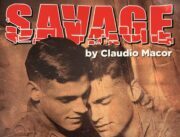
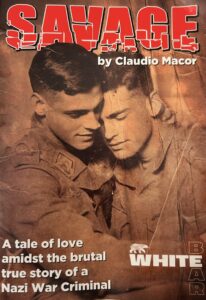
SAVAGE 
White Bear Theatre, London
Gay Conversion Therapy shockingly remains legal in around 170 countries, including the USA and the UK. Savage, a play written by Claudio Macor, examines a particularly horrifying period in the history of conversion therapy, namely that carried out by the Nazis during World War Two.
On at London’s cute White Bear Theatre in Kennington – one of London’s many excellent pub theatres – Savage shines a light on the Danish doctor, Carl Peter Vaernet. He was a Nazi sympathiser who operated in Copenhagen during the beginning of its Nazi occupation. He believed that he had discovered a ‘cure’ for homosexuality, moving on from Copenhagen to experiment on legions of homosexual prisoners at the Buchenwald Concentration Camp. His beliefs were in tune with the Nazis who were seeking to eradicate ‘abnormal existence’ ie: homosexuals. Despite being a war criminal, he was never prosecuted by either the Danish or the liberating British forces, and after the war, he escaped to exile in Argentina. His crimes and the lack of prosecution have been covered up by both the Danish and British authorities and it’s only due to activists such as Peter Tatchell that we know about this gruesome creature. Very heavy subject matter, but don’t let that put you off. Savage is as much a historic tale of queer love and survival as it is about homophobia.
 It’s a dark night in 1940 in Copenhagen. Beautiful Georg (Jonathon Neilsen-Keen) shimmers in a floor-length green sequin gown as the drag queen performs her last number on the last night before her dimly-lit gay nightclub closes down due to the Nazi occupation. The local queer community are being arrested one by one by the Nazis, most never to be seen again. It’s just not safe to go to bars and clubs. Lovers Zack (Matthew Hartley) and Nikolai (Kerill Kelly) leave the show to walk home. Horror strikes as Nikolai is arrested by the Nazis on the way back. Zack works for the American Embassy so he is safe from arrest, but Nikolai has no chance. Before he knows it, Nikolai is naked in the operating room of Dr. Vaernet (Mark Kitto). Tied to an operating table by the doctor’s reluctant assistant (Clare-Monique Martin), the doctor performs awful experiments on him to ‘cure’ his homosexuality. Zack has been speedily transferred out of Copenhagen by the embassy, so he is not around to help rescue Nikolai. Meanwhile, Georg has also been picked up by the Nazis and has been forced to be the lover of a closeted, alcoholic Nazi officer, Obergruppenfuehrer General Heinrich von Aeschelman (a brutish Tom Everatt). How are things going to pan out for these apparently doomed young gay men?
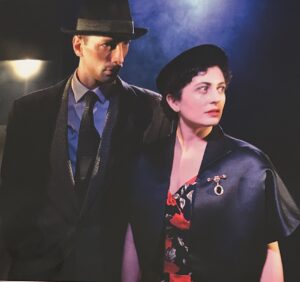 Savage is an ambitious play. Eight characters over two countries and a time span of five years would seem like a tough call on a four-metre squared stage in eighty minutes. Director Robert McWhir has, however, risen to the challenge. We are in the club, the homes and the operating theatre with these characters. There’s a remarkable authenticity and the tension is high, the dim, lonely lighting bringing the room together as the audience silently shares the on-stage trauma. The cast is all excellent. Kitto is suitably horrible. Neilsen-Keen shines as the feisty George, refusing to kowtow to his thug Nazi ‘boyfriend’. Martin is also a stand-out as the doctor’s assistant, despite her somewhat lacklustre script, who eventually finds herself and her voice. Kelly is fully game (and often naked) as the brutalised Nikolai. A lot is going on, and sometimes it feels like a series of subplots rather than one main storyline. Maybe that’s the intention. I’d have liked to see Zack and Nikolai’s relationship fleshed out more, though. Overall, however, this is original storytelling done well.
An important part of queer history we should all be aware of.
| Queerguru’s Contributing Editor Ris Fatah is a successful fashion/luxury business consultant (when he can be bothered) who divides and wastes his time between London and Ibiza. He is a lover of all things queer, feminist, and human rights in general. @ris.fatah |
