
We can always trust director Jeffrey Schwarz to deliver compelling documentaries about queer social history. The maker of I Am Divine, Tab Hunter Confidential, The Fabulous Allan Carr, Boulevard! A Hollywood Story and Vito is back with Mineshaft: The Cruising Murders, the story of the controversy around the making of the 1980 queer cult-classic film Cruising.
Cruising starred Al Pacino and was set in late 1970s New York´s Greenwich Village, then the ground zero of the city’s gay scene, particularly the leather BDSM scene. Pacino plays an undercover cop who infiltrates the world of the Mineshaft leather bar to try and find a serial killer who’s preying on its patrons. The thriller was inspired by true events, in particular the 1977 murder of Variety writer Addison Verrill. Director of Cruising, William Friedkin, was driven to make the film when he realised he knew Paul Bateson, the man charged with Verrill´s murder. By coincidence, Bateson had featured in Friedkin´s 1973 classic masterpiece The Exorcist.
New York in the late 1970s was a gay man’s paradise. Emboldened by 1968´s Stonewall riots, the next ten years saw a surge of gay men flock to the city from all over the US. Homophobia was still rife but within the relatively self-enclosed world of Greenwich Village it was possible to live your best queer life in the glut of gay bars, clubs, cruising, sex stores and restaurants. The mainstream media, however, were not allies and queer visibility on screen and in the press was invariably full of negative connotations. Gays were portrayed either as victims, jokes, addicts or misfits, never as normal. Once news spread about the filming of Cruising, with its focus on the BDSM scene of the Mineshaft, local queer activists decided to protest and disrupt production, fearing more negative portrayals of queer life.
Schwarz splits Mineshaft: The Cruising Murders into three sub-narratives. We have the life story of murder victim Addison Verrill, the making of Cruising itself, and the huge protests of the queer community around the making of the film.
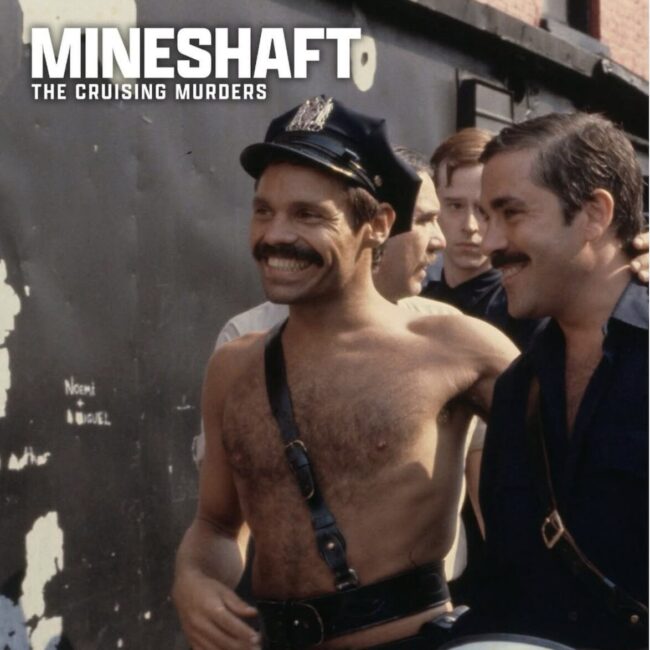
We begin with 36-year-old Verrill´s story. Verrill made full use of NewYork´s gay leather scene – the BDSM bars and clubs – Mineshaft, Badlands, The Anvil, Hellfire Club and so on, as well as the cruising areas on the Piers and the Trucks, empty container trucks parked on the Westside Highway at night which were full of men having sex. The scene was exhilarating but also risky – murder, violence and robbery were not unusual. His ex-partner Bob Geary and his sister Pamela are valuable talking heads, as well as various well-known protagonists of the time, including Michael Musto and Vito Russo. Dan Savage also contributes. Verrill´s life was a mixture of queer domesticity with Geary, glamour with his Variety job, and full-on leather scene hedonism.
Then we move on to Friedkin´s production of Cruising. Friedkin loved exposing little-known subcultures to the world. The heterosexual director spent months on NY´s leather scene at night, often clad only in a jockstrap, watching and listening to ensure the authenticity of his direction. He also spent time visiting his friend Bateson in Riker’s Island prison. He cast real-life members of the scene as extras, and plied them with booze and drugs to ensure the club scenes were as authentic as possible. Apparently, this extended to real fisting scenes making the final edit of the movie. Buoyed by the success of The Exorcist, and also fuelled by his love of gritty realism, Friedkin felt no boundaries to his work. Pacino was a willing partner – he connected to gay men whom he felt shared his outsider mentality.
Next we learn about the protests against the film. Various local queer activists got hold of leaked copies of the script. Alarmed at what they expected to be a horror version of the leather scene, with no balancing mainstream portrayals of gay men in the film, they set about to sabotage production. Friedkin was shooting on location in Greenwich Village, so it wasn’t hard to find the locations. Plus Greenwich Village was full of queer activists. Word spread quickly about each shoot, and up to a thousand men would congregate and shout, throw things, and generally disrupt proceedings. Production carried on regardless, even though Pacino had to duck for cover at times. Splits within the community occurred as many of its hottest men were cast as extras in the film, eager to earn money portraying their authentic queer leather man selves. A dream come true for some. At the time, there wasn’t a range of queer films showing different sides to queer life. This was a big Hollywood film and the protestors were fearful of it being the only portrayal of gay men to middle America. Tensions were high in 1979 as Harvey Milk had just been murdered and freaky old Anita Bryant was on the warpath. I must say, though, that as a closeted sixteen-year-old watching Cruising in suburban England in 1982, I felt nothing but excitement for the future. In the end, the film didn’t reach a huge audience and died quickly. Today it´s a cult classic. The protests did, however, help change the way that gay men were portrayed on screen.
Schwarz has gone to great lengths to source amazing archival footage which combines beautifully with the narratives from many original protagonists from that era. An edgy soundtrack by Makeup and Vanity adds to the mix.
Mineshaft: The Cruising Murders is an important queer social history lesson. There’s so much to see and learn, and few other ways today to garner the information shared. That world is gone forever, its demise brutally hastened by the beginning of the AIDS crisis just two years after the film’s 1980 release. Powerful, empathetic, beautiful, and well-balanced storytelling. 
|
RIS FATAH SENIOR CONTRIBUTING EDITOR London & Ibiza Queerguru Contributing Editor Ris Fatah is a successful fashion/luxury business consultant (when he can be bothered) who divides and wastes his time between London and Ibiza. He is a lover of all things queer, feminist, and human rights in general. |

Comments
2 responses to “Queerguru´s Ris Fatah reviews ‘Mineshaft: The Cruising Murders’, a brilliant documentary by Jeffrey Schwarz about the controversy around the cult 1980 queer film Cruising.”
[…] Mineshaft: The Cruising Murders is an important queer social history lesson. Jeffrey Schwarz always delivers compelling documentaries about queer social history. This story of the controversy around the making of the 1980 queer cult-classic film Cruising.is one of his best. There’s so much to see and learn, and few other ways today to garner the information shared. That world is gone forever, its demise brutally hastened by the beginning of the AIDS crisis just two years after the film’s 1980 release. Powerful, empathetic, beautiful, and well-balanced storytelling. […]
[…] P.S. You can read QUEERGURU’S full review of the film HERE […]