

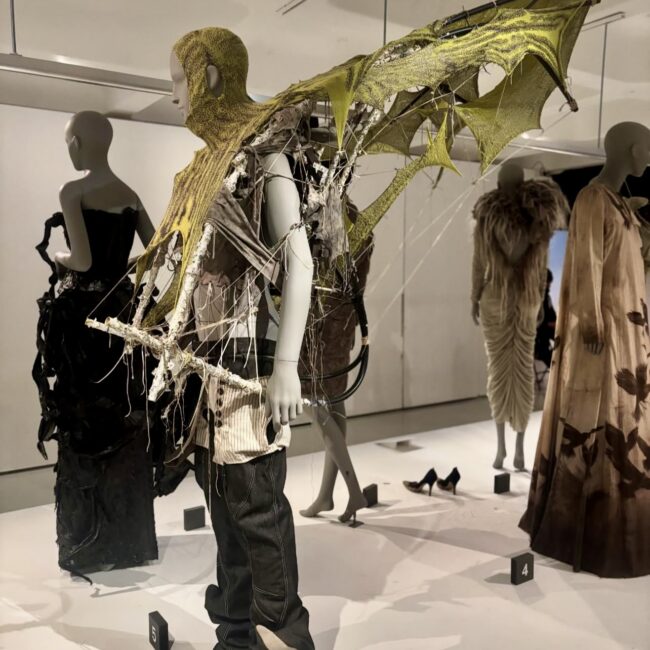
Scrolling through TikTok or Instagram, or walking down London’s Sloane or Bond Streets, you could be forgiven for thinking designer fashion was all about pristine, very smart looks. Fashion, however, has had a dark, distressed side for decades.Dirty Looks: Desire and Decay in Fashion, the first fashion exhibition at London’s excellent Barbican Art Gallery for ten years, examines the ‘dirty’ aesthetics of the fashion world from the 1980s to the present day. The word ‘dirty’ has a wide scope here – from literal dirt, mud, and so on, through to politics, body fluids, fashion’s unsustainability, recycling, decay, and rebellion. The result is an excellent, far-reaching coming-together of the great and the good dirt from over sixty fashion designers from all over the world.

The entrance to the show presents two pairs of wellington boots, one, a clean pair, owned by the late Queen Elizabeth II, the other, a pair splattered with festival dirt, owned by another British Queen, Kate Moss.
Room 1 begins with the work of iconic designer Hussein Chalayan. Hussein used to bury and exhume his clothes, with different results depending on where and for how long he buried his clothes, and what with, for example, copper filings. This is a trip down memory lane to the 1993-2002 work of this now-often-overlooked genius designer.
We then step back further with pieces from the AW 1982 Nostalgia of Mud collection by Vivienne Westwood and Malcolm McLaren. This collection wanted to explain how the roots of our culture lay in primitive societies. This work is shown alongside similarly inspired pieces by various other designers such as Issey Miyake and Alexander McQueen.

The next room features romantically decaying evening wear, a popular theme with designers since the 1990s. Alexander McQueen, Olivier Theyskens and Victor & Rolf all feature here, as do Comme des Garcons and Robert Wun amongst others.
The ideas of torn, worn and artificially-aged fashion have long been popular. Think the beats, hippies, punks, new wave, the goths, grunge and so on. We want to feel authentic, rebellious and romantic at times. The next group of designers have all explored this and include Martin Margiela’s iconic work, as well as John Galliano’s and Balenciaga’s amongst others.
The next sections feature stains on garments – piss, sweat, paint, wet-look – including Helmut Lang’s iconic 1998 paint-splattered jeans. I was once refused entry into Harrods wearing a pair of these. When I complained, stating that I had bought them there, the curt reply stated that they also sold bikinis and customers were not allowed to enter the store wearing those either. Touche! Harrods obviously doesn’t subscribe to Dirty Looks. Our judgment re stained clothes is pushed in front of us here.

Other sections include the use of trash in fashion, also fire, explosives, scorching, ancient bogs and so on. There’s more, too much to mention here. The result is a thought-provoking trip and a timely reminder that we don’t need to look smart to look good. This is a compelling, well-curated and comprehensive show. Work by contemporary designers is also given a strong focus to avoid the show feeling too vintage. I always find fashion exhibitions a little static, and this show is no exception. To me, the person wearing the clothes is always more important than the clothes, and that is lost here in a show primarily shown on rather dull mannequins. There is also little video footage. More would have been welcome, as well as some photography of the clothes being worn in the shows they were in. I suppose the clothes are the stars here. Overall, it’s an excellent reminder of the breadth of the definition of beauty and a ‘stick-that-in-yer-pipe-and-smoke-it’ prod to the conservative establishment which never likes dirty looks.
Recommended 
Dirty Looks: Desire and Decay in Fashion is on at London’s Barbican until 25th January.
| Queerguru’s Contributing Editor Ris Fatah is a successful fashion/luxury business consultant (when he can be bothered) who divides and wastes his time between London and Ibiza. He is a lover of all things queer, feminist, and human rights in general. @ris.fatah |
