
 Fifty Best lists of (whatever the subject) may seem like two a penny, and compilations of the best LGBT films are easy to find online or in reference surveys such as 100 Queer Films Since Stonewall, published by the BFI in 2025. These listings usually include titles like Happy Together, Maurice, Victim or Priscilla Queen of the Desert.
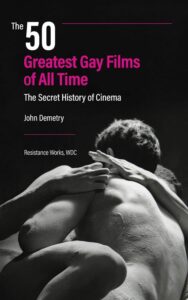
A newly published compilation, 50 Greatest Gay Films of all time by John Demetry, drops all but the first title, offering a punchy, provocative view of the secretive nature of influential gay films. Organized with a range of subheadings, the publication is short on frills, with no color photos or glossy cover, but look closer, as this offers more than meets the eye.
Firstly, the categories in which to group fifty films edge towards the poetic, with Number one described as “Transcends.” The chosen film here is David Lean’s 1962 Lawrence of Arabia, directed by a classic old-school heterosexual filmmaker, in which it is possible to sift through grains of sand and find what Demetry describes with text that includes: “Lean perceives Lawrence’s motivations in sexual terms after he takes two Arab boys under his wing that leads to demise staged like a lover’s death. This desert is hot ..a heat that burns.” A remarkable acknowledgment for a film not generally considered to be a gay film.
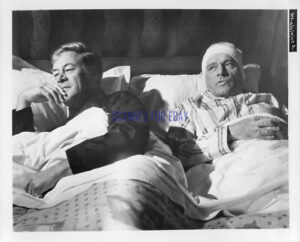
If you like Demetry’s aesthetic choice of words, there are plenty more on offer. Mankiewicz’s film of Tennessee Williams’ Suddenly Last Summer unravels with “suppressed memory surrounding a gay aesthete’s bizarre death….a garden of obscene overgrowth, a carnivorous moral universe.” John Huston’s film of Carson McCuller’s Reflections in a Golden Eye contains this choice text: “A title card announces tragic inevitability when square lives scrape against society’s round holes.” How true this is, with eyes drawn into Marlon Brando’s married army Major, consumed by repressed psychotic lust to be penetrated by a soldier who rides naked through the woods on a thoroughbred horse. Demetry’s text reveals a writer who loves the world of men, as he does the gaze seen through a filmmaker’s gay lens.
 As a secret history of the genre, the writing limits itself to one film per creator, so it doesn’t explore links between Fassbinder’s Querelle and Fox and his friends, or between Bertolucci’s The Grim Reaper and The Dreamers. Perceptive descriptions of Minnelli’s Tea and Sympathy, Honoré’s Winter Boy and Stanley Donen’s Staircase are more than welcome. The piece also mentions no filmmakers with key contributions to gay cinema, including Rosa von Praunheim, Derek Jarman, Pier Paolo Pasolini, Andrew Haigh, Sergei Parajanov, William Friedkin, Alan Guiradie, or Todd Haynes. The writing does not flesh out the thought behind banishing films like Call Me By Your Name, Moonlight or Love, Simon to the unloved and dispossessed. Another area of research not considered is the secret gay subtexts in the origins of both Noel Coward’s Brief Encounter and Terence Rattigan’s The Deep Blue Sea, which various film treatments allude to.
 The most recent film included, and quite rightly so, is Robin Campillo’s Enzo (2025) which raises questions as to the absence of other new films including Kanawade’s Cactus Pears or Tuttle’s Blue Movie. Surprising is why Demetry bypasses what may be the cinema’s most noble and influential expression of love between men: Jack remembering and caressing the fabric of Ennis’s shirt during the closing moments of Brokeback Mountain.
As a vivid account of cinema’s secret history, the writing is robust enough to raise questions about why gay cinema has yet to produce a definitive expressionistic study along the lines of Andrew Sarris’s The American Cinema. Sarris created categories, including The Pantheon, Far Side of Paradise, Strained Seriousness, Less than Meets the Eye, and Subjects for Further Research, that defined American cinema auteurs. There are now enough films in the gay canon to warrant this insight, and Demetry provides perceptive, aesthetic credentials.
No reference list is likely to be definitive, though 50 Greatest Gay Films of all time remains a provocative, handy addition to our bookshelves. In the case of this reader, it has inspired pulling out for viewing an overlooked DVD of Julian Hernandez’ Mexican film Raging Sun, Raging Sky from 2009. Demetry places this on the pedestal as the greatest gay film of the 21st Century. High praise indeed.’
| THE 50 GREATEST GAY FILMS OF ALL TIME is published by Resistance Works WDC 2026 and can be purchased on Amazon |
|
PETER HERBERT : CONTRIBUTOR LONDON He is Curator Manager of The Arts Project supporting a wide range of artists linked to The Arts Project and London’s legendary LGBT+ Loudest Whispers Arts exhibition. He writes about a wide range of film and enjoys the scope of QueerGuru to spread the world of queer and LGBT+ arts. Peter also enjoys hanging out with his loving husband, family and friends on a sun facing terrace near Chalk Farm, filled with metal and plastic action men bursting into life while enjoying the forces of nature. |

Leave a Reply