


Astitva – Jaivant Patel (choreographer and director)
The Place, London, Euston
There’s something deliciously unsettling about the opening of Astitva, Jaivant Patel’s new dance work at The Place. The audience files in to find the dancers already on stage, moving slowly, almost tentatively, as though we’ve walked into a ritual already in progress. A traditional Indian bowed string instrument hums continuously in the air—palatial, ancient, hypnotic. Then suddenly: bursts of Freddie Mercury, Whitney Houston and other glorious fragments of 80s teenage obsession for those of us who were there at the time. Two cultural sound worlds, Western pop and a classical South Asian raga (an original score from Alap Desai) colliding in our ears.
The effect, not unlike that of the film All of Us Strangers with its use of Frankie Goes to Hollywood’s ‘The Power of Love’, was a transportation back to my undiscovered queer childhood—the otherness (differing in this case from my own because I am a queer white man and this piece is particular to brown South Asian queer identity), the school bullying, the hostility, in Wolverhampton the place of my birth and incidentally the same place where Jaivant Patel’s dance company was founded and is based. I grew up amongst a culturally rich South Asian community in the West Midlands, predominantly Sikh, from where many similar creatives sprung (see Meera Syal who went to the local grammar school). So, for myself, whilst the characters on stage were othered for different reasons, there was also the strange and very immediate sense of feeling at home with these beautiful men, my brown queer brothers.
Visually, Astitva is quite gorgeous. The stage sits in a haze of orange and blue light, the dancers’ taut bodies (Amar Bains, Dominic Coffey, and Mithun Gill) picked out by rim lighting so they appear almost sculptural—muscle, sweat, and shadow. The choreography moves through something recognisably queer: hostility, internalised shame, tenderness, the push and pull of desire, and finally something like acceptance. There are moments of intimacy that feel fragile and very human.
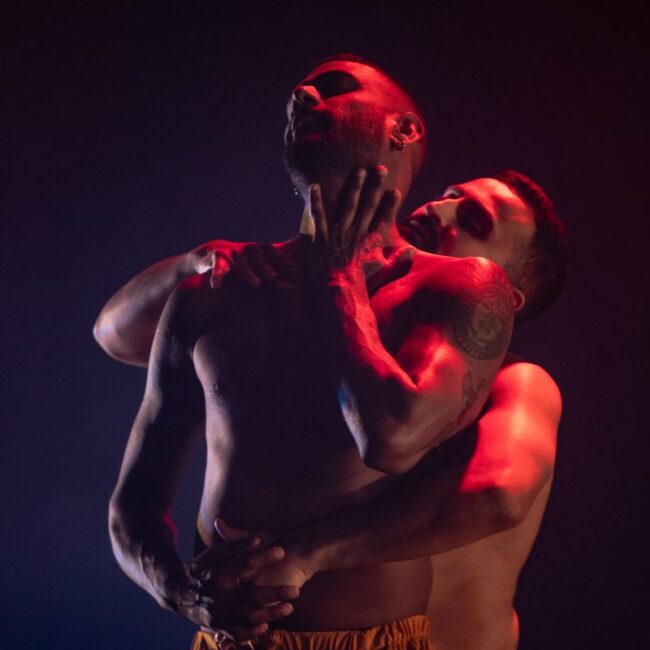 The only element I wasn’t quite convinced by was the occasional spoken interjections from the dancers. While they endear us to the piece, they arrive a little abruptly and feel somewhat detached from the otherwise cohesive physical language of the piece. I found myself wondering whether they should either be leaned into much more—to be embroidered into the fabric of the entire piece—or quietly dropped altogether. But these are small quibbles. Astitva is a striking, sensual work—full of atmosphere, bodies, longing, and that particular tension that comes when different versions of yourself are trying to exist at the same time.
And frankly, I’m always happy to sit in a dark theatre watching beautiful men move poetically through blue haze while Freddie Mercury wails somewhere in the background. This was a wonderful way to spend an evening—a bold and powerfully evocative interpretation of queer male South Asian life at odds with tradition, culture, religion and stereotypes. I enjoyed and connected with every minute.
 Justin David is the publisher at www.inkandescent.co.uk He is also the author of Tales of the Suburbs, Kissing the Lizard and The Pharmacist. Justin David is the publisher at www.inkandescent.co.uk He is also the author of Tales of the Suburbs, Kissing the Lizard and The Pharmacist. |
