
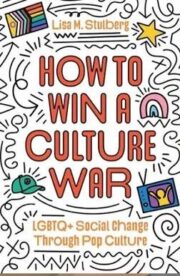
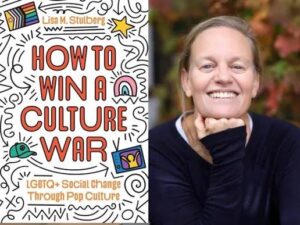
It’s rare for a new book to circulate around the Queerguru Office and spark such a heated discussion… especially when it’s about social changes in our own queer community. The title ‘How To Win a Culture War’ promised to explore the important role played by pop culture in development in the book written by Lisa M. Stulberg, who is an associate professor of sociology of education at New York University’s Steinhardt School of Culture, Education, and Human Development and an affiliated faculty member in the Department of Sociology at NYU.
We want to know more. We needed to know more. So after playing phone tag for seemingly ages, we finally caught the Professor on the phone and fired away all these questions her book had raised
QG: Your book argues that pop culture has been one of the most powerful engines of LGBTQ+ social change. Why do television, film, music, and sports sometimes succeed in changing hearts and minds where politics often fails?
LS: This is definitely a paradox: the politics of the past few years have become increasingly anti-LGBTQ+ while pop culture has generally become more LGBTQ+-inclusive. I think the answer lies in the reach of pop culture and the intimate way we relate to it.
We feel closely connected to the characters we love on TV, the athletes we root for, and the musicians we listen to. We let them into our homes and our lives, and in the process we may come to care about people who are different from us. While we are being entertained, we may not even realize that we are learning and letting something new in.
You interviewed 170 actors, writers, athletes, musicians, and activists over fourteen years. Was there one story or interview that fundamentally changed how you think about social change?
More than any one interview, I think the cumulative impact of talking with so many people who are excellent at what they do reminded me how important art and pop culture are.
I was also surprised by how many people did not think of their culture work as explicitly political. They simply wanted to excel at their art or sport, and were happy if that work also contributed to social change. That changed how I think about social change: it is important to devote yourself to social justice, but it is also important to do what you love and what you are good at in a way that contributes good to the world.
One of your central ideas is that culture workers use six strategies to create change. Which is the most difficult to sustain in today’s political climate?
The six strategies I highlight are: become visible; use available platforms; change your workplace; overachieve; become normal; and stay queer.
Right now, I think changing the workplace is especially difficult. We have seen pressure to scale back or abandon DEI efforts, and, in Hollywood, the creative opportunities that opened up during the streaming boom have narrowed. Storytelling increasingly leans toward what is considered the “safe” gamble. Anything outside that middle is often labeled too “risky,” too “political,” or too “niche.”
As the political Right continues to attack efforts to embrace diversity and inclusion, it becomes increasingly difficult to move workplaces toward full LGBTQ+ inclusion in labor, storytelling, and representation.
You discuss becoming visible as a form of activism. In an era when visibility can bring both opportunity and intense backlash, how do public figures decide whether speaking out is worth the risk?
Visibility is especially fraught right now, because social media creates both opportunities for self-determination and openings for backlash. This has real consequences for people’s safety and well-being.
I could never answer this question for anyone else, especially since I don’t share LGBTQ+ identity. Visibility is a personal decision and, ideally, a choice people have agency over—though they often don’t. It also doesn’t affect everyone equally. People with other forms of power and privilege may have more control over their privacy and be less vulnerable to the dangers of visibility.
I spoke with many people who believe queer visibility is incredibly important and have put themselves in the public eye, while also recognizing that invisibility can sometimes be a necessary, life-saving survival tactic.
Your book highlights household names like Eric McCormack, Lea DeLaria, and Greg Louganis and many behind-the-scenes creators. Why is it so important to recognize the people audiences rarely see?
The behind-the-scenes people—writers, showrunners, producers, directors, casting professionals, and others—do so much of the labor of telling great stories. In many cases, they have had to fight homophobia, transphobia, racism, and other forms of ignorance and bigotry to get those stories made.
These creatives are the engine of so much incredible storytelling. They are also “in the room,” where they can bring their perspectives to the creative process and speak up when something doesn’t seem right. Hearing from them helps us understand how meaningful changes in art and pop culture actually happen.
You use the late-2025 television phenomenon Heated Rivalry as an example of how much has changed. What does its success tell us about where American culture is today—and where it still has room to grow?
I’m a huge fan of the show and have been fascinated by the public response. Its success shows that queer stories can sell. We already knew this, but in a moment when Hollywood decision-makers have pulled back, it is an important reminder that what is good for business can also be good for social justice.
The show’s success also demonstrates that many people needed a story about queer joy and love. I was especially moved seeing an online video of a bar full of people cheering when Scott and Kip kissed on the ice. It was a collective moment of joy and cheering for love—a striking contrast to today’s political effort to dehumanize queer people.
But there is still enormous room to grow. Queer people remain underrepresented in mainstream media, especially women, trans and nonbinary people, and queer people of color. Heated Rivalry is one great example of how an unexpected queer story can shatter expectations and hopefully make room for the next one.
One of your most intriguing strategies is “staying queer.” What does that phrase mean, and why is it essential even as LGBTQ+ representation becomes more mainstream?
I use “normal” and “queer” deliberately because these are terms that came up repeatedly in my interviews and have been central to LGBTQ+ movements for decades. They raise the question of whether becoming similar to the mainstream or remaining distinct from it is the more effective strategy for social change.
For “staying queer,” I draw on sociology, critical race theory, and feminist theory to argue that the margin itself has power. People who have been marginalized often develop an outsider’s view that allows them to see the center of society clearly.
Many people I interviewed described growing up as outsiders and developing a heightened ability to observe, empathize, find humor, and understand other people. As one TV writer told me, “I had to suffer, so now I’m funny.”
“Staying queer” doesn’t mean that mainstream culture or “becoming normal” aren’t important. It means recognizing that distinct culture, community, and the perspective of the margins can also be powerful forces for social change.
You’ve written that progress often comes through storytelling rather than arguments. What makes a compelling story more persuasive than statistics or political debate?
Stories build connection and empathy. When we become immersed in a good story, we grow to love its characters and understand their experiences, often across differences that might otherwise divide us.
Several people I interviewed described comedy as a kind of “spoonful of sugar” or “Trojan horse”—a way of bringing an idea to audiences who might resist a direct political message. The goal is usually not to preach; it is to tell a good story. But that storytelling can open hearts and minds through laughter and connection.
Your research spans major legal victories, growing representation, and a renewed wave of political attacks. What lessons from previous generations give you the most hope right now?
History shows us that anti-queer politics are not new. After World War II, queer people were purged from the military and federal government and portrayed as dangerous to the nation. During the AIDS crisis, gay men were framed as diseased and unsafe while the government failed to respond humanely. During the fight for marriage equality, LGBTQ+ people were portrayed as threats to children.
We are seeing similar rhetoric today, particularly toward transgender and nonbinary people.
But in each of these moments, art, pop culture, and sports have provided community, education, empathy, beauty, and resistance. During the AIDS crisis, for example, the television movie An Early Frost (1985) helped educate a huge audience about AIDS, while Pedro Zamora used The Real World (1994) to talk openly about living with HIV.
These examples remind us that culture can fill a void when politics fails—and can help people see one another as human.
|
For more information on Lisa M. Stulberg: For all details of her current Book Tour, |

Leave a Reply