
In 1967 Phil Green and Ken Burton, who were tailors and partners, known to their friends as Aunt Rose and Aunt Esmé opened a fashion story at 31 Bond Street in Brighton, UK called Filk’n Casuals (say that carefully).
Some of their clothing was considered rather daring and attracted a certain type of gentleman it was soon considered ‘the most notorious outfitters outside of London’ (British Queer History, Brian Lewis).
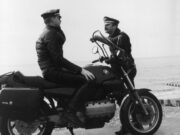
 They were initially very successful and their clientele included ‘all sorts of very famous people’. Ken developed a discreet sideline creating leather and rubber wear for a more specialist crowd. In the 1970s, he and fellow gay leather enthusiasts were hanging out with straight biker gangs, mixing at seafront bars in Brighton. Meeting like-minded men to dress up in leather and play with each other was difficult, and a Motor Sports Club provided good cover for their activities, so they decided to form their own group: the Sussex Lancers.
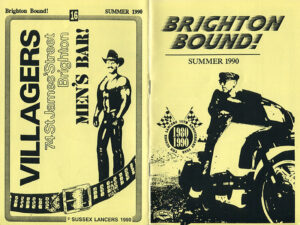
 In 1980 they began meeting at the 42 Club on King’s Road, a gay club since the 1950s, now the Brighton Rock Shop. The Lancers were there for four years before moving to the Villagers, a bar with a basement club at the Kemptown end of St James’ Street, currently the Black Dove. Oh if those basement walls could talk… the passion, the discos, the raffles. Having a city-centre base for almost a decade helped the club thrive and it reached 150 members at its peak. In the late 1980s, it was a familiar sight to see groups of leathermen and guys in uniform and rubber, strolling between bars in what is now ‘the gay village’.
While officially a non-political organisation, the Lancers rose to the challenge when times got tough. They joined marches in London, for Gay Pride, against Section 28, and supported ‘the Sussex AIDS Helpline and Gay Switchboard who need their time and money’
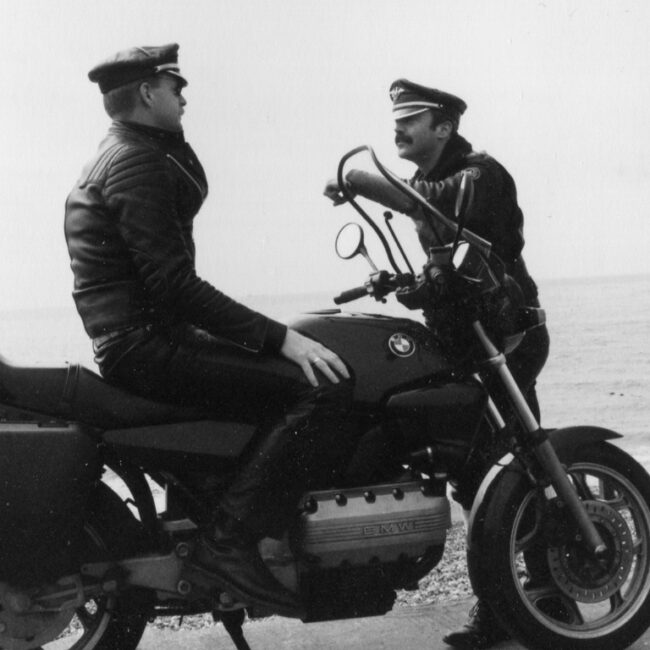
The first person in Brighton to die from AIDS was in 1984. By the end of the 1980s the HIV infection rate in Brighton was 12 times the national average and the highest per capita in Europe . AIDS had a huge impact on the Lancers:
|
The impact of HIV/AIDS, and the development of a commercial fetish scene saw Lancer membership dwindle from the mid-1990s, and the club hung up its boots in 2001. Despite their beginnings as a secret boys’ club, the Lancers proved themselves to be socially conscious and a part of the Brighton queer scene that is now pretty much gone.
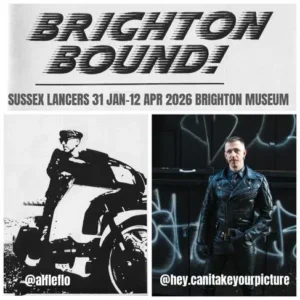
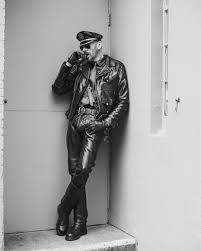
Now The Brighton Museum is having a retrospective of this crucial part of local queer history: The Sussex Lancers: Tailor-made Leather Lovers, which also includes new photographs by Antony Edwards, which present a contemporary view of the Sussex leather scene and its lasting cultural legacy.


Comments
One response to “The Sussex Lancers: Tailor-made Leather Lovers ; an Exhibit at Brighton Musuem UK”
thank your for this article, keep up the good work