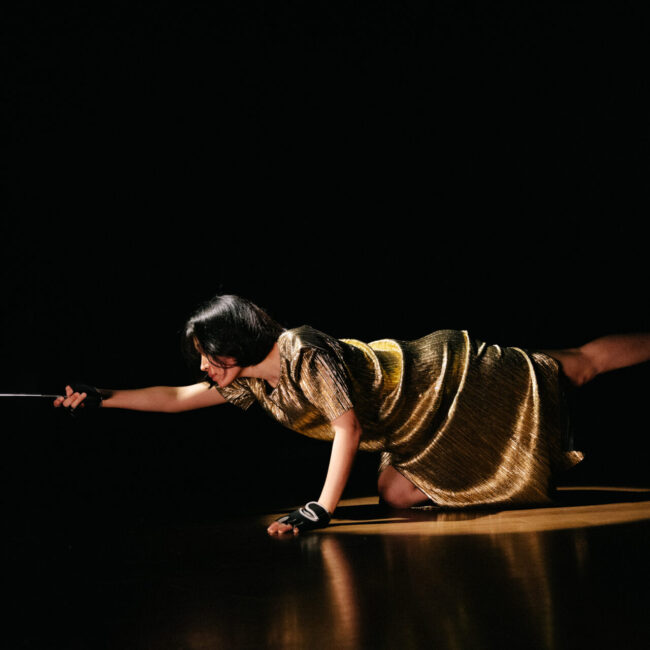
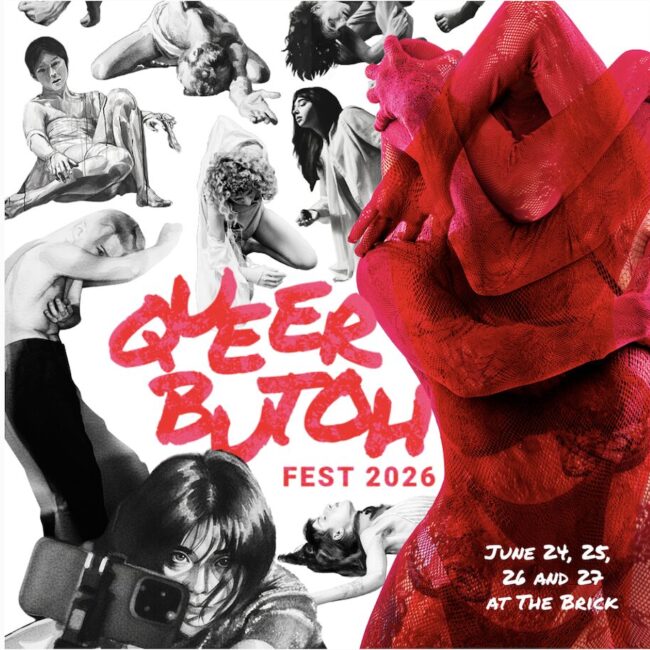
Queer Butoh Festival returns to New York City with four evenings of interdisciplinary performance exploring the evolving landscape of Butoh in NYC and beyond. This year’s festival brings together local and international artists from Mexico, Belgium, South Korea, Singapore, Chile, and across the United States, highlighting Butoh as a global and ever-evolving art form rooted in transformation, experimentation, and radical presence.
 The festival will feature performances across all four nights by Fana Muñoz and Moisés Regla (Mexico), Camille Raséra (Belgium), Miu Kim (South Korea), and Dani Cole (NYC). Additional featured artists include New Yorkers Milo Longenecker (USA) on June 24–25, Zo Roze (USA) on June 24 and 27, Oscar Suh-Rodriguez (Chile/USA) on June 25–26, Eric Lichtenstein (USA) on June 26, and Robyn Wong Min Xuan (Singapore) on June 27.
Vangeline is a New York-based teacher, choreographer, and dancer specializing in Japanese Butoh. She is the artistic director of Vangeline Theater / New York Butoh Institute and is widely recognized for her rigorous, research-driven approach to Butoh and for expanding the form’s relevance in the 21st century. Her work actively champions diversity and inclusion, creating space for historically underrepresented voices while carrying forward the legacy of Butoh through contemporary research, activism, and performance.
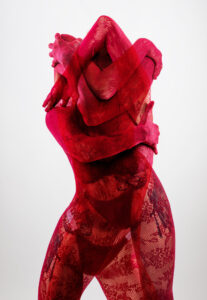 Through her all-female dance company, Vangeline creates socially engaged, innovative choreographic works that unite Butoh with activism. She is the founder of the New York Butoh Institute Festival, dedicated to uplifting women in Butoh, and Queer Butoh, a festival centering LGBTQ+ voices within the form. She is also the visionary behind the Dream a Dream Project, an award-winning program now in its 18th year that brings Butoh into correctional facilities across New York State.
At the heart of Vangeline’s philosophy is the belief that Butoh can serve as a tool for both personal and collective transformation. Her work reflects a deep commitment to integrating the full spectrum of human experience—beauty and darkness alike—while reintegrating voices historically marginalized by society.
Her work has been widely acclaimed both nationally and internationally, with critics praising its power, precision, and emotional resonance. Reviews have appeared in publications including The New York Times (“captivating”) and The Los Angeles Times (“moves with the clockwork deliberation of a practiced Japanese Butoh artist”),
|
New York Butoh Institute Announces 2026 Queer Butoh Festival June 24–27, 2026 at 8pm |