
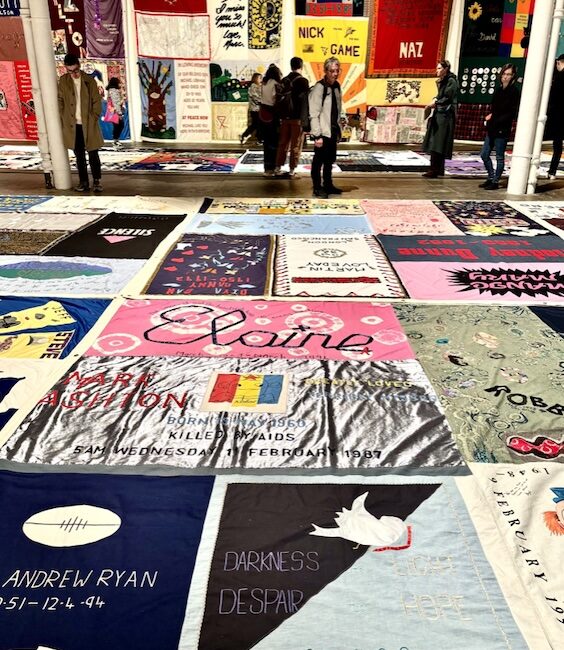
While crowds file past the Bayeux Tapestry in London, in Glasgow this is the last weekend that the full UK AIDS Memorial Quilt is on display at the commanding and capacious Tramway Arts Centre.
Consisting of 336 panels commemorating the lives of more than 600 people lost to HIV and AIDS, each 3ft x 6ft rectangle is roughly the size of a typical grave plot. Laid across the floor and pinned to the walls, together they create an awe-inspiring spectacle.
For such a serious installation, the first impression is surprisingly not a solemn one, but a joyous response to a glorious patchwork of colour. Bold lettering, names and dates leap out and demand attention. Every panel deserves to be read, from the famous to the infamous and, in some cases, the anonymous. The saddest panels have no photographs or surnames because the families of the deceased were too “ashamed” to be publicly connected to their kinsmen.
Naïve crayoned banners and simple cut-outs sit alongside sophisticated graphics and exquisite needlework. An extraordinary variety of patterns and textures, and several shiny things. Tartan and chintz, silk and tweed, sequins and glitter. Photographs of handsome young men—many with moustaches—are accompanied by poems and messages from lovers, friends and family.
Actors, explorers, artists, pop stars, fashion designers, drag queens and the boys next door. One panel simply says, MUM. Personal passions, from Hibernian Football Club to Starlight Express, are explored with fondness. Flags from many nations and text in foreign languages appear. There is order and chaos. It is a collage of lives that were varied, full and loved.
And look at the dates. The average age at death is about 33.
Cleve Jones conceived the first AIDS Memorial Quilt in 1985 in San Francisco, and the idea soon caught on, becoming the largest community art project in the world. In the UK, Scottish activist Ally Van Tillo (formerly Alastair Hume) began bringing together our own version, originally stored in Edinburgh, where Ally lived with his husband and helper, Ian Van Tillo.
(Photo of Ally Van Tillo by Joe Magowan, 2025)
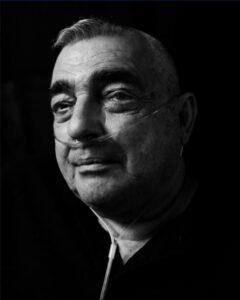
Sadly, Ally passed away on 30 August this year. Shortly before his death, he had this to say about the Quilt’s exhibition at Tramway:
“The UK AIDS Memorial Quilt has come home to Scotland. From 1989 and throughout the 90s, the Quilt found a home in Leith, helping people make sense of their loss and humanising individuals that our government and media were painting as perverts and social pariahs.
“But its significance today is not just historical. Language used to ostracise gay people has not gone away, and the queer community is once again under threat…
“The AIDS Memorial Quilt is the world’s biggest community art project. It is non-threatening and non-judgemental, yet no less powerful for it.
“Queer history for the most part is lost, because so many lived in shame and shadows. The AIDS Memorial Quilt is alive: let’s ensure no more of our history is allowed to disappear.”
The atmosphere in the huge Tramway space is hushed and reverent. The crowd ranges from cool international students to wee Glasgow grannies. Straight folk, queer folk and everyone in between.
Some people are visibly overcome with emotion, silently wiping away tears. I hear one older man say he feels overwhelmed. I can only imagine how many more painful memories are being recalled in that room.
One hopes that, like the Bayeux Tapestry, the AIDS Quilt will continue to be seen by the public for hundreds of years. It is not simply a memorial to those who died: it is a historical record of one of the worst tragedies of our times, and a fitting testament to the value of those lives that were cut short.
|
While it waits for a permanent home, the Quilt will continue to travel around the UK. Some of the panels can next be seen at The Coast is Queer festival in Brighton from 15–18 October. To view all the panels and for more information, visit aidsquiltuk.org. |
|
ROBERT MALCOLM CONTRIBUTING EDITOR Edinburgh
He is a trained architect and interior designer who relocated from London to his hometown of Edinburgh in 2019. Under the pen name of Bobby Burns he had his first novel, a gay erotic thriller called Bone Island published by Homofactus Press in 2011.
|

Leave a Reply