

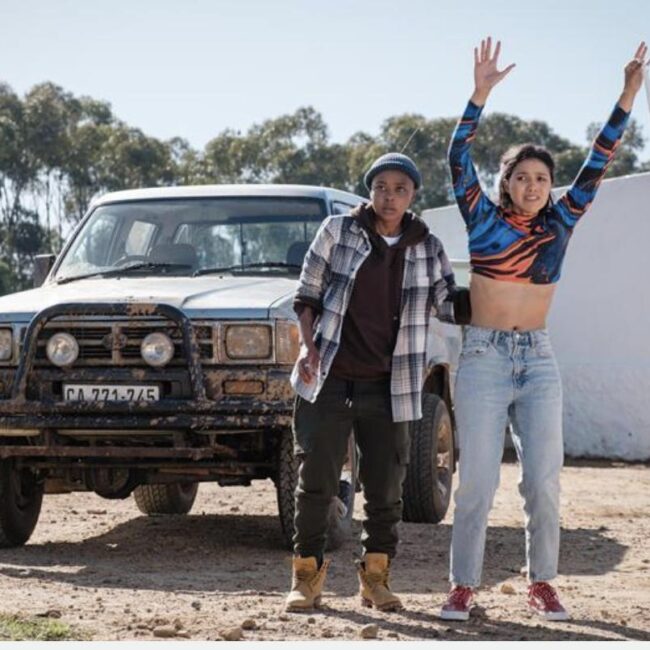
Low Rider is the latest film by London-based director Campbell X (Stud Life). His work examines themes of colonisation, longing, and Blackness across the African diaspora and Low Rider continues in that vein.
We meet Quinn (Emma McDonald), a slightly scatty, naïve, low substance – high maintenance, Gen Z Londoner. Her mother has recently passed away, leaving her bereft. Going through her mother’s possessions, she finds notes to herself from the father she never met. Realising that he had been trying to contact her, she decides to travel to Cape Town to try and find him, not knowing his exact whereabouts.
On arrival in Cape Town she visits his last known address, to no avail, but is informed that he has moved to a town quite far away. She drowns her sorrows in a cool queer club where she briefly meets local driver Harley (Thishiwe Ziqubu), a transman who shows an interest in her, before hooking up with a hot young woman with whom she returns home. This night is messy and sexy, and Quinn wakes up the following morning having lost her phone and her purse. A friend lends her some cash and she quickly realises that her only option to try and find her dad is to enlist the inexpensive help of driver Harley.
Thus begins a road trip across the South African countryside in a battered old Toyota Hilux to try and find Quinn’s father. The pair experiences a gamut of emotions and experiences as they slowly connect. Where are we heading?
The queer road trip movie is a frequent vehicle for storytelling and personal journeys. Whilst Low Rider does feature a few familiar tropes, the setting of South Africa, with its epic landscapes, high crime rates, diverse racial communities, and complex geo-political past and present, does give this film a point of difference. The film builds from a fairly flat start to an interesting, more complex second half with some interesting twists and turns. A couple of scenes here are stand-out. Both McDonald and Ziqubu are believable; the two very different people are gradually finding common ground. Ziqubu in particular shines as portraying his racial/socio-economic disadvantage amidst the often (slightly stereotypical) gun-toting, hillbilly white Afrikaans communities they travel through. “Just because things are familiar doesn’t mean they’re the same.“
Great cinematography combines with a cool soundtrack to highlight the themes of loss, racial, gender, and sexual identity, intimacy issues, letting-go, and the journey to self-acceptance. We don’t always need what we think we need. 
| Queerguru’s Contributing Editor Ris Fatah is a successful fashion/luxury business consultant (when he can be bothered) who divides and wastes his time between London and Ibiza. He is a lover of all things queer, feminist, and human rights in general. @ris.fatah |

Leave a Reply