
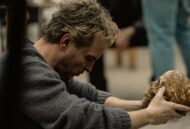
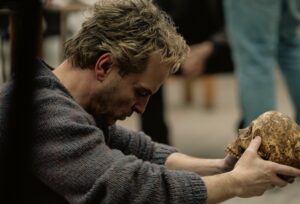
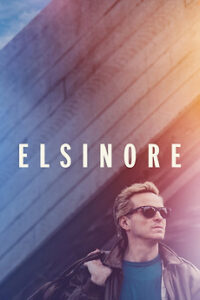
The 70th London Film Festival opened on 7/10/26 with the gala premiere of Elsinore, a sensitive film starring actor Andrew Scott. The film tells a little-known story about the final years of Scottish actor Ian Charleson as he confronted his mortality during a production of Shakespeare’s Hamlet at the National Theatre. The film is an engaging triumph for director Simon Stone and Andrew Scott playing Ian Charleson, with a strong ensemble cast.
Elsinore is set in England during the late 1980s/early 90s when the HIV/AIDS virus brought major loss of life to the gay community. Ian Charleson was a trained actor who received worldwide fame in Hugh Hudson’s 1981 film Chariots of Fire. His career began on the fringe in Derek Jarman’s anti-establishment cinema and with an early performance as Hamlet. After mainstream success, Charleson’s career included Attenborough’s film Gandhi with Opera his final 1987 film made in Italy for the flamboyant Dario Argento. It was well known that Charleson commented he had also become more associated with Vangelis’ music for Chariots of Fire than his acting profile.
 Elsinore opens with the actor at a low and quiet point in his life while promoting the release of Opera. He is aware of a dangerous virus affecting gay friends and soon discovers a rash on his body followed by his own positive diagnosis. At the same time, Daniel Day Lewis has walked out of a National Theatre production of Hamlet unable to cope with his father’s death
As Charleson’s mind and body spiral into unsettling ways, interactions with friends and family intensify. These include Derek Jarman (played by David Dawson), who criticizes the actor for selling out to the mainstream and disowning early work, including playing a naked angel in Jarman’s 1978 punk film Jubilee. During a scene filmed outside Jarman’s cottage in Dungeness, he also encourages Charleson to admit his AIDS diagnosis to the world during a time of fear and prejudice towards the gay community. Another strikingly conveyed character is stage and film director/filmmaker Richard Eyre (played by Johnny Flynn) and the dilemmas faced with Charleson’s casting.
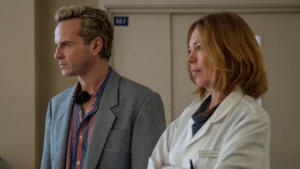
Scenes of cruising on Hampstead Heath with The Sisters of Perpetual Indulgence handing out condoms are honest and accurate. Life on the NHS HIV/AIDS ward at The Royal Free Hospital (now The Ian Charleson Day Centre) include details of the nickname Elvira and the use of Ethel Merman’s torch song “There’s No Business like Show Business “reveal the warm, generous nature of Charleson. There are also touching performances from Luke Thompson and Joe Locke as fellow patients. With a life in freefall providing the opportunity to rediscover and connect, Elsinore reveals how a new sense of family and community can envelop lives. These include Juliet Stevenson’s on-stage mother figure becoming another off-stage figure and Olivia Colman is Margaret Johnson, the pioneering doctor who helped many people to live longer and better lives during the race to find a vaccine.
 The director’s background as an established stage director enriches the film’s understanding of theatre and the craft of acting, while the structure at the heart of Stephen Beresford’s script and Stone’s direction carefully reflects viewpoints of the central performance.
Elsinore is more than a passion project or labour of love with the centre of the production firmly in the hands of Andrew Scott, one of our finest contemporary gay actors of stage and screen. The actor is building a rich and varied career including an intense character study in the TV series Ripley (2024) and what may be his finest film work in All of Us Strangers (2023) where the actor blooms under the sympathetic hand of Andrew Haigh.
Elsinore provides the actor with a beautifully nuanced theatrical performance reflecting the film’s structure and subject matter. As the film is largely shot with a sense of long /medium shot framing, it is electrifying where close ups of the actor’s face reveal deeply moving feeling and mood through the power of the eye.
Scott recalls the measured acting film style of the gay English actor Dirk Bogarde, particularly in his later career. There is a temptation to find links between both Scott’s portrayal of an actor and that of Bogarde’s musician confronting life and death at the end of Visconti’s 1971 film of Thomas Mann’s Death in Venice. As another place of value and meaning, Elsinore could be viewed as Death in Elsinore, with Scott’s performance confronting life’s mortality during the closing of the light of day into the darkness of night.

|
PETER HERBERT : CONTRIBUTOR LONDON. He is Curator Manager of The Arts Project supporting a wide range of artists linked to The Arts Project and London’s legendary LGBT+ Loudest Whispers Arts exhibition. He writes about a wide range of film and enjoys the scope of QueerGuru to spread the world of queer and LGBT+ arts. Peter also enjoys hanging out with his loving husband, family and friends on a sun facing terrace near Chalk Farm, filled with metal and plastic action men bursting into life while enjoying the forces of nature. |

Leave a Reply