
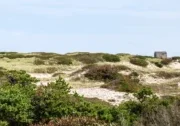
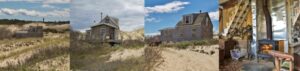
Wherever we live in the world it is impossible to avoid ‘change’ even in this tiny spec at the end of Cape Cod we call home. This is Provincetown, which started out as the first stop for the Pilgrims, then became a Yankee whaling village, a Portuguese fishing town populated by the descendants of immigrants from the Azores who came to work in the whaling village, a thriving artist community, and now a popular destination for LGBTQ residents/tourists.
There are no hotels here, just a series of charming guest houses and Bed and Breakfasts owned by individuals and gay couples, who have made this into such an essential for the queer community, but now some big commercial concerns with bulging wallets are moving in, and buying up some of the larger establishments. Whilst we wait with bated breath to see if this latest ‘change’ will be good for our much beloved town, we are reminded that for a few visitors, there is always a chance to avoid all this and live just the good old days
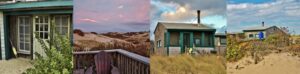
The Dune Shacks of Peaked Hill Bars Historic District is an artist colony and historic district which d covers 1,950 acres of land and centers on 19 extant dwellings that have been occupied by American artists and writers from the early 1920s to the present day.
These shacks were built reputedly using the flotsam of washed up shipwrecks were appealing to the many artists and writers who had begun to be attracted to the artist’s colony in Provincetown; they would live in the spartan solitude of the shacks writing or painting. Probably the most famous of these was playwright Eugene O’Neill, who purchased one and spent many summers there with his second wife, Agnes Boulton. O’Neill penned Anna Christie (1920) and The Hairy Ape (1921) while living in his shack, and in doing so gave the whole collection of dune shacks something of an arty cachet.”
Other artists and writers lived in the primitive dune shacks, including Harry Kemp who proclaimed himself “the Poet of the Dunes,” Jack Kerouac, E. E. Cummings, Norman Mailer, and Jackson Pollock. In 2016, musician and artist Jacob Bannon stayed in one of the dune shacks for seven days painting and recording music, culminating in the release of a book and album both under the name Dunedevil. The shacks have never had electricity, plumbing, or running water.
Today, there are 19 dune shacks in the historic district, 18 of which are owned by the National Park Service, and three of them are adminstered by The Provincetown Community Compact who operate a scheme to rent them out each summer
The shacks are primitive — no electricity or indoor plumbing — and isolated, allowing for uninterrupted solitude and refuge.
Community residencies are open to all and are selected by lottery. The Compact funds, or partially subsidize, residencies for three visual artists who are selected by jury and for two writers who are selected by lottery.
In 2019 The Provincetown Community Compact designated one of the three Dune Shack Artist Residencies for an emerging artist of color, named for the late David Bethuel Jamieson, an African-American artist who died of AIDS in 1992. The top recipients of the Dune Shack Artists residency and the David Bethuel Jamieson Residency include three funded weeks in the C-Scape Dune Shack and a $500 fellowship. In keeping with their mission, The Compact provides fully funded weeks for clients of the AIDS Support Group of Cape Cod, Helping Our Women, the Provincetown Schools, and Native Americans. These time slots are funded by the annual Provincetown Swim for Life & Paddler Flotilla – a benefit for AIDS, women’s health & the community.
| Chack out https://thecompact.org/dune-shacks.html. for further detailed information and application forms
Applications for 2026 are open until January 15, 2026. |
