


In Ukraine, L.G.B.T.Q soldiers can risk their lives for the state, but if they are wounded or killed, the partners who love them are legal strangers in the eyes of that state. Even though in 2023 the European Court of Human Rights found that Ukraine’s lack of legal recognition for same-sex couples was discriminatory and violated the right to private and family life. A bill to create registered partnerships was introduced that year but remains stuck in Parliament. The legal gap has always been unbearable; then the war with Russia seemed as though it would make that disparity untenable. Surely, queer soldiers visibly defending the nation from the front would render the hypocrisy of Ukrainian law too obvious to sustain. But the gap remains.
This past weekend in ROMANIA, a PRIDE March went ahead despite it being banned for the fourth consecutive year. Ark Oradea, the event’s organisers, reportedly submitted more than 100 potential routes for the march to take, but the city’s municipality rejected all of them and declined to grant permission for the fourth year in a row.
Nicu Ştefănuţă, the Vice President of the European Parliament said. “It is shameful for the Romanian state of the European unfreedoms what is happening now in Oradea. People from all over Europe and at least eight European embassies are marching.” This shame won’t wash away easily,
Meanwhile in POLAND, the president vetoed and refused to sign same-sex relationship recognition bills. The country’s coalition government backed the bills that MPs approved. President Nawrocki, a socially conservative Catholic, in a statement said they “create a new, formalized institution of family law, equipped with a broad catalogue of rights similar to those of marriage. The new measures would have allowed same-sex couples who live together to enter into “cohabitation contracts.” Reuters noted the bills would have allowed same-sex couples to make decisions on issues that include access to medical information, property rights, and burial.
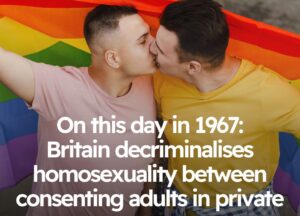
| It’s Only a Matter of Time: On this day in 1967: The Sexual Offences Act partially decriminalised homosexuality in England and Wales, legalising sex between two men in private, provided both were over 21. The reform excluded the armed forces and merchant navy, did not extend to Scotland or Northern Ireland (which followed in 1980 and 1982), and set the age of consent far higher than the 16 that applied to heterosexual couples, a gap not fully equalised until 2001. |
