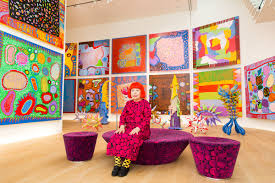
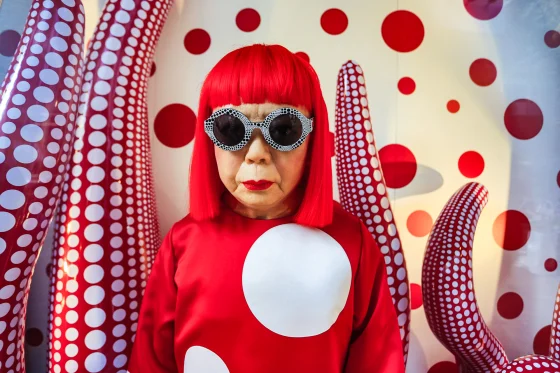
Life, or losing it, really does come in threes. First the angel superstar Miss Dolly Parton, then the world’s best-ever cross-dressing Rocky Horror Tim Curry, and now the death of Japanese avant-garde artist Yayoi Kusama has just been announced. Now we wonder why we’re all seeing spots. Literally.
Kusama, who became famous for her colourful polka dot-covered sculptures and installations, has died at the age of 97. The woman was nothing less than an artistic genius Ms. Kusama first gained attention in the late 1950s and early ’60s with immense abstract paintings that she called “Infinity Nets.” They were composed of countless small, curving strokes of paint on all-white or all-black surfaces, suggesting a giant, swirling mesh pierced with pinprick holes.
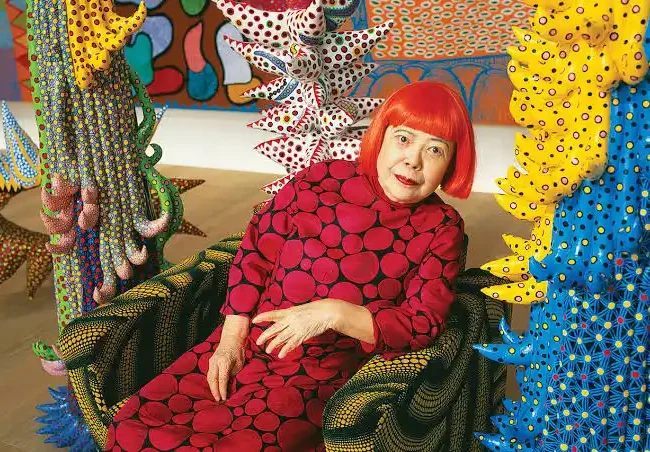
Creating art incrementally from repeated components became Ms. Kusama’s mode of working, and she applied it to sculpture as well. In the early 1960s, she began sewing thousands of stuffed fabric phalluses, painting them white or gold and gluing them onto the surfaces of everyday objects — tables, armchairs, coats, shoes, a baby carriage, a rowboat — to create bristling, room-filling installations.
These “Accumulation Sculptures” made their debut, along with work by Claes Oldenburg, James Rosenquist and Andy Warhol, at a group show at the Green Gallery in New York in 1962. It was among the first exhibitions of Pop Art, and with it, Ms. Kusama was recognized as a pioneer in the two major avant-garde styles of the day, Pop and Minimalism.
Although her work was often seen as assertively erotic, its intended effect was the opposite. As she explained in her autobiography, “Infinity Net,” published in Japan in 2002 and later in the United States, she found sexual organs threatening, a reaction that she traced back to infantile experiences. Yet she frequently had herself photographed lying scantily dressed or naked on fields of tumid forms.
In 1955, three of her paintings were sent to New York to be included in an international watercolor exhibition at the Brooklyn Museum, and she began to make plans to move to the United States.
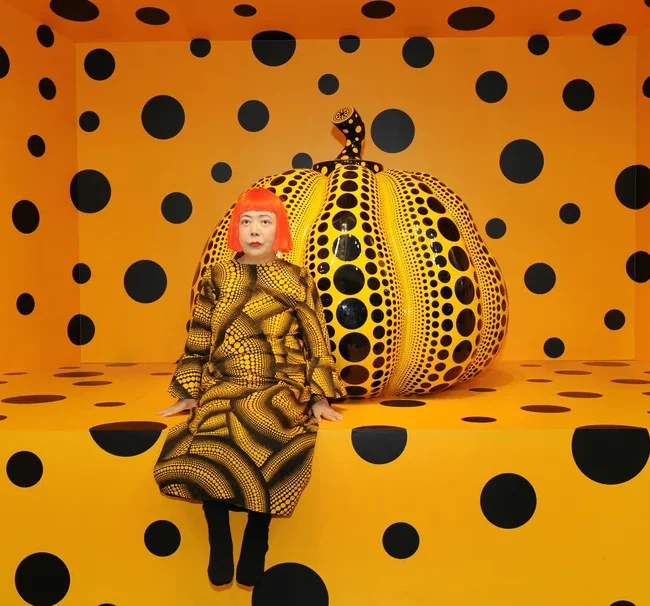
In the late 1990s and early 2000s, she returned to creating encompassing installations for the first time in three decades: rooms covered entirely in polka dots and mirrored “Infinity Rooms.” When one of her 1960 “Infinity Net” paintings sold for $7.1 million at Christie’s in 2014, it was the highest-priced work by a living female artist ever bought at auction.
The allure of her personal presence increasingly became a component of her art. She was aware that as an Asian woman in New York she was seen as an exotic outsider in the city’s art world, an identity that had useful marketing potential. Despite all her activity ir was not enough to stave off her panic attacks and hallucinations, which became acute. In 1977, she admitted herself to the Seiwa psychiatric hospital in Tokyo. She would eventually make it her permanent home, building a studio nearby.