


The word icon is probably too widely overused, especially in the LGBTQA+ community, but having said that, there can be no doubt that the late German queer filmmaker Rosa von Praunheim was one. Film director, author, producer, professor of directing and one of the most important representatives of the New German Cinema and in over 50 years, he made more than 150 films (short and feature-length films). He was also one of the most influential and famous queer activists in the German-speaking world.
Born in East Germany, from which he and his family escaped in 1953, and when he began his career, he adopted the female stage name Rosa von Praunheim to remember the pink triangle that homosexuals were forced to wear in Nazi concentration camps, as well as the Frankfurt neighborhood of Praunheim where he grew up.
| The Museum of Modern Art‘s website says of his film It Is Not the Homosexual Who Is Perverse, But the Society in Which He Lives: “Rosa von Praunheim’s radical treatise on gay culture and politics exploded post-Stonewall activism in the early 1970s, and has internationally redefined queer liberation ever since.” |
 It was this film which led to many gay rights groups being founded and was the beginning of the modern lesbian and gay liberation movement in West Germany and Switzerland. The film also made Rosa von Praunheim the leading figure of the lesbian and gay movement in West Germany: “With this film, Rosa von Praunheim became the icon of the gay and lesbian movement in Germany almost overnight.” (Deutsche Welle).
von Praunheim was one of the most influential and famous queer activists in the German-speaking world, and also considered the enfant terrible of the German New Wave. He was Germany’s most commercial underground film-maker but unlike his peers such as Wenders and Fassbinder, his films remained resolutely oppositional and on the fringe.
With the outbreak of the AIDS epidemic, von Praunheim worked on films about the HIV-related disease. A Virus Knows No Morals (1986) was one of the first feature films about AIDS internationally: “A Virus Respects No Morals, a savage, imaginative, scattershot Brecht-like allegory set largely in a gay bath, became one of the earliest and most provocative attacks on the hypocrisy, ignorance, politics and economics surrounding the AIDS crisis.” (Los Angeles Times)
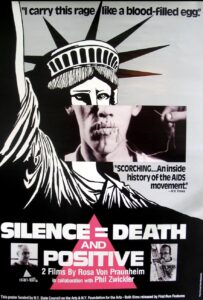 The docs Positive and Silence = Death, both shot in 1989, deal with aspects of AIDS activism in New York City. Fire Under Your Ass (1990) focuses on AIDS in Berlin.[24] For the so-called AIDS trilogy, von Praunheim was awarded the LGBTIQ-Film-Prize of the Berlin International Film Festival. The Guardian, one of Britain’s most important newspapers, wrote in 1992: “Silence = Death and Positive: The best AIDS films to date […].The Los Angeles Times summed it up: “In short, Praunheim is just the man for the job he has taken on with Silence = Death and Positive: he has the breadth of vision, the compassion and the militance and, yes, the sense of humor necessary to tackle the AIDS epidemic in all its aspects.“
 His final work, “Satanic Sow” (2025), became a legacy film: autobiographical and experimental, serving as both a reflection on his life and a farewell. Von Praunheim described the film as “a poem — and a very experimental one at that.” When asked why he made it, he responded simply, “I make films and plays all the time, so there’s no particular reason. I just do it to be creative.”
Just a few days before his death, Rosa von Praunheim and his long-time partner Oliver Sechting got married. After his death was announced, the German President publicly honored von Praunheim, acknowledging his significant role in changing German social reality, especially for the LGBTQ+ community. The President had previously congratulated von Praunheim on his 75th birthday in 2017, highlighting how von Praunheim’s art, though often scandalous, achieved what few artists could: genuinely altering society.

| Rosa von Praunheim 25 November 1942. – 17 December 2025 (aged 83) |
