

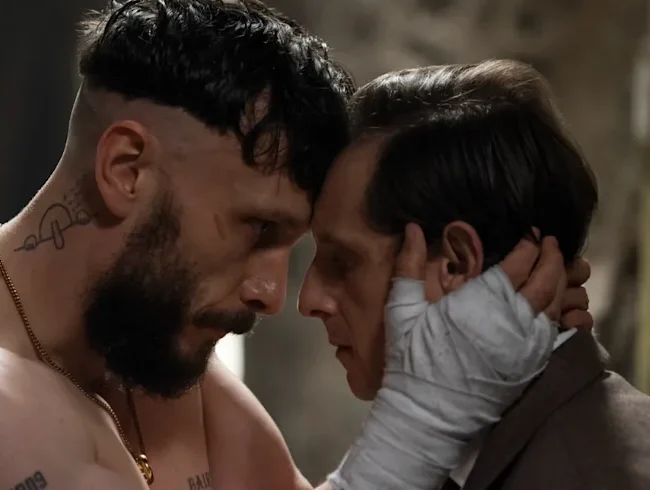
I have to admit that I approached Richard Gadd’s new BBC and HBO series, Half Man, with some reservations.
The violent working-class Scotsman is a trope that is too familiar and reinforces a national stereotype that the country can well do without. I was also concerned that this tale is told by Gadd, a middle-class Scottish writer and actor whose experience of his subject matter – unlike his autobiographical rôle in Baby Reindeer – is not first-hand.
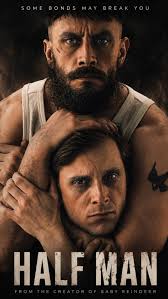 Putting this aside, I was able to concentrate on the story and enjoy the authentic voices of Mitchell Robertson and Stuart Campbell, the actors playing young Niall and Ruben, and the exceptional Neve Mackintosh as Niall’s mother, Lori. Jamie Bell as the grown-up Niall, sympathetically portrays the adult character’s flaws and contradictions, while Richard Gadd’s Ruben is a volcano constantly waiting to erupt.
Gadd’s accent and mannerisms aren’t quite right, but if Half Man falls short in an accurate depiction of a working-class Scottish hard man, it succeeds as a valid exploration of repressed homosexuality and toxic masculinity, which can be understood across cultures.
Half Man may refer to both characters – each man completing the other – but it may also refer specifically to Ruben. Ancient civilisations share myths of creatures which are half man and half beast. Minotaurs, centaurs, and satyrs are half bulls, horses and goats. They have human qualities but are ruled by their baser instincts.
I wish that the mythical nature of this tale had been emphasised. How much more interesting would this series have been, for example, if its muted eighties style cinematography had been replaced by dramatic high contrast black and white?
The tale begins with Ruben, uninvited, in black leather, ominously arriving by motorbike at Niall’s wedding. The story then unfolds in flashback.
When Niall and Ruben were teenagers, their mothers lived together as a lesbian couple. Niall was a quiet, bright and studious, sexually ambiguous boy. When the older, violent, and unpredictable Ruben is released from a young offenders institution, he comes to stay with the women and shares a bedroom with Niall. Thus begins a complicated love-hate relationship between the boys, who describe themselves as “brothers from another lover.”
Both lads have absent dads, and in the case of Ruben, his personality problems stem from physical abuse by his father. Niall’s mother is aware of Ruben’s history and is more sympathetic to Ruben than Niall would like her to be.
Niall, ashamed of his shy feminine side, admires Ruben’s confident masculinity but is resentful of his mother’s affection for him. Shockingly, he finds that he is also sexually attracted to Ruben and is aroused by his violent outbursts.
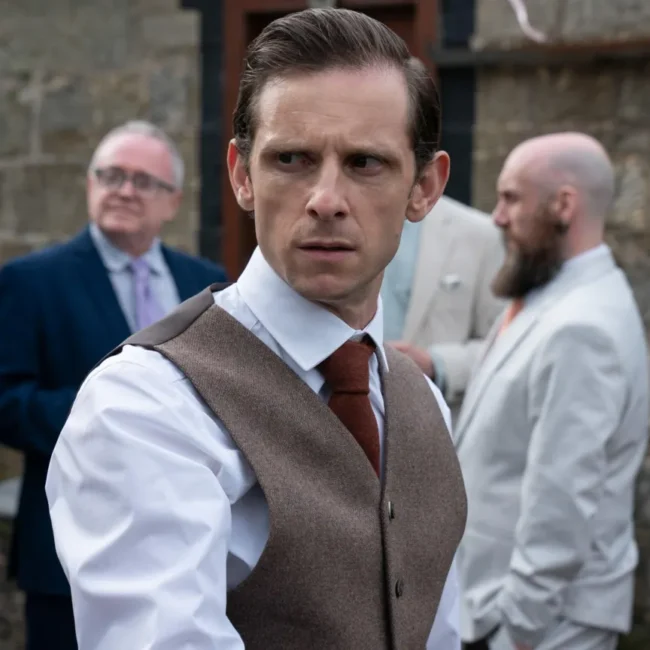 Ruben is a traditional, dominant, heterosexual male who becomes Niall’s protector and provider. Envious of Niall’s intelligence and aware of his weakness, he uses force to control him, but after Niall helps him cheat in an exam, he defends Niall by beating up the school bully. This unhealthy codependent relationship is suffocating and as he leaves home for university, Niall promises that he will quit Ruben for good.
However, during a period of loneliness and sexual confusion, rather than confiding in his mother, Niall phones Ruben. Ruben arrives at the Glasgow student residences to support his “brother” but leaves a trail of bloody chaos and trauma in his wake. He is dutifully arrested and imprisoned.
Niall’s sexual repression and guilt turn into self-loathing, and following university, after a long period of anonymous hook-ups with strangers, he pays for help to curb his homosexual impulses and settles down with a girlfriend.
Without giving away the many twists and turns in the plot, Niall uses underhanded tactics, lies, and psychological warfare with Ruben to gain the upper hand. Each time he uncovers Niall’s scheming, Ruben resorts to violence. As Niall never learns from his actions, one begins to wonder if he is unconsciously or even consciously provoking Ruben. When Ruben finally turns his life around and gains control over his anger, it is a jealous Niall who pushes him back over the edge.
In the last episode, after another period of sex and drug addiction, Niall, who is now a successful author, is reunited with the other man in his life, a boyfriend from university, and is persuaded to come out to Ruben, who is once again in prison. This leads to Half Man’s most emotional scene, when the “brothers” reveal their true feelings for each other.
However, unable to let sleeping dogs lie, Niall follows up with a confession – or is it a boast? – which seals his fate.
I began by saying that this story is allegorical and is best appreciated if not taken at face value. It has similarities to the Biblical myths of Cain and Abel or Jacob and Esau, and it also reminds me of the work of queer French author Jean Genet. It turns conventional morality on its head and, offering no easy answers, makes one simple statement – men are beasts.
Men separate love and sex. Crudely put, Ruben loves Niall obsessively but does not want to have sex with him, while Niall obsesses about having sex with Niall but does not want to love him. The frustration and anger that both men feel lead to their downfall.
I think that with Half Man, Gadd took on a huge challenge. He set out to write an epic tragedy and has mostly succeeded. It is a unique and unsettling saga, but to make its point, some of the dialogue is forced. The narrative is also stretched to its limit to facilitate the final outcome, but if Half Man gets us talking seriously about male violence, anger, sex, shame, and repression – not to mention love – he has done his job well.
All episodes are now available to stream on BBC iPlayer and HBO

|
ROBERT MALCOLM
 . CONTRIBUTING EDITOR Edinburgh . CONTRIBUTING EDITOR EdinburghHe is a trained architect and interior designer who relocated from London to his home town of Edinburgh in 2019. Under the pen name of Bobby Burns he had his first novel, a gay erotic thriller called Bone Island published by Homofactus Press in 2011.
|
