

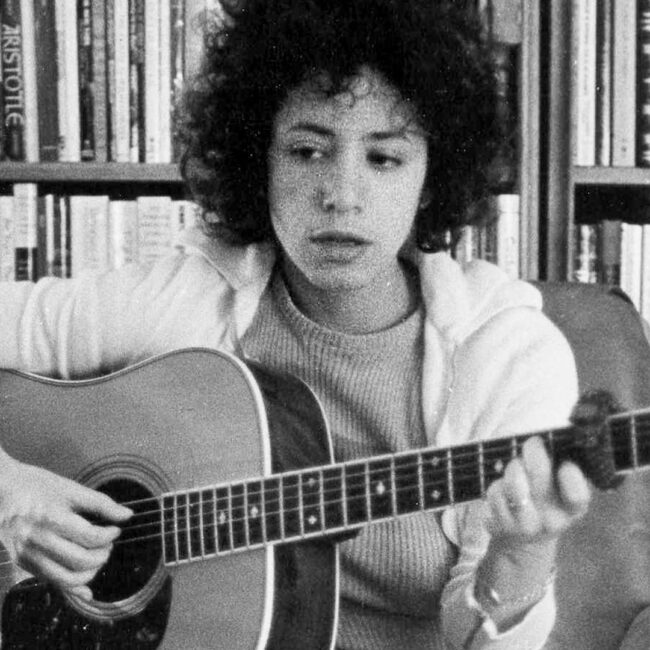
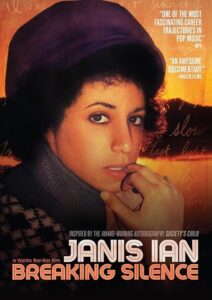
Janis Ian is the queer icon you may not be aware of. The documentary, Janis Ian: Breaking Silence, seeks to redress that, detailing the life and times of the legendary, Grammy-award-winning, American folk singer/songwriter.
 Celebrated for emblematic tracks such as “At Seventeen” and “Society’s Child,” Ian’s illustrious career began as a twelve-year-old in mid-1960s New York’s Greenwich Village. Born into a liberal Jewish family in New Jersey, at her own insistence, she began learning the piano at age 3. At the age of 12, she wrote her first song, Hair of Spun Gold, which was published by the influential folk magazine Broadside. However, it was her first hit, written and released at age 14, Society’s Child, about an inter-racial romance, that shot her to fame and notoriety. Her bohemian world in Greenwich Village was accepting, open-minded, and into fellow local residents and performers Bob Dylan, Joan Baez, BB King and so on. Middle America, however, wasn’t ready to hear about mixed-race relationships and Ian was subject to radio-bans, bomb threats at gigs, booed off stage and struggled to get a record deal. Her public treatment was appalling. It was yet another of America’s ugly, racist periods. Ian refused to back down, inspired by her parents’ inclusive values, and held out, her youthful strength and naivety guiding her to her moment. It was a 1966 TV appearance on Leonard Bernstein’s show that truly set off her career, and the single ended up selling 600,000 copies. Things were looking up for Ian, touted as the new Bob Dylan, working with Janis Joplin, playing with Jimmy Hendrix etc, when Bill Cosby, in another of his flawed actions, publically denounced her as a lesbian after he saw her innocently sleeping on a chaperone’s lap backstage one time. This led to further ostracism, even though she hadn’t even kissed a woman at this point.
A period of poor physical and mental health followed, not helped by an addiction to sleeping pills and being spiked with very strong acid. The early 1970s saw her move to LA, fall in love with a woman and release two great albums, Stars and Between The Lines. Her queerness was accepted in the post-Stonewall California glow. Her music was covered by stars such as Cher, Nina Simone, Bette Midler and Roberta Flack and her most iconic single, At Seventeen was released in 1975. She performed this on Saturday Night Live, as their first ever musical guest. She won a Grammy in 1976 and started playing big gigs, including with Bruce Springsteen and Billy Joel.
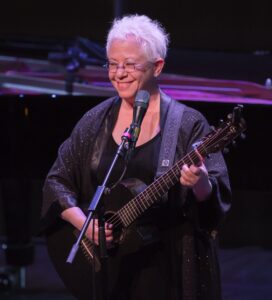 Her full-on life continued, including a tempestuous, abusive five-year marriage with a gun-toting man, film-maker Tino Sargo, the 1979 release of a fabulous single Fly Too High, about gay men having fun in bath houses, a bankruptcy caused by a fraudulent business manager, a sick mother, and a controversial, sanctions-breaking tour of apartheid-stricken South Africa. A penniless, broken Ian eventually moved to Nashville in the late 1980s to rebuild herself. A couple of relationships with women followed before Ian finally settled down and married Patricia Synder, the love of her life. She came out formally in 1992, did all the talk shows to promote queer visibility and wrote a regular column for The Advocate. This coincided with the worldwide release of her album Breaking Silence. Many more singles, albums and Grammy nominations have followed, adding up to a six-decade legacy of great music.
Director Varda Bar-Kar has created a comprehensive tribute to Ian. She uses a combination of voice-over by Ian, interviews with contemporaries such as Joan Baez (looking amazing it has to be said), Lily Tomlin and Arlo Guthrie, vintage photographs and footage of Ian’s iconic performances, re-enacted key moments from Ian’s life and animation to tell Ian’s fascinating story. Ian is a generous contributor, after having avoided many previous attempts by others to tell her story. Some of Bar-Kar’s techniques, such as the animation and the re-enactments, are unnecessary and clutter up the documentary. Overall, it’s Ian’s voice-over and the vintage footage that should be centre stage. At the insistence of Ian, Bar-Kar tells the story in the context of the social history, particularly the queer and racial social history of Ian’s life. The vintage footage of Ian is very special – her voice is unique and in many ways she helped pave the way for people like Tracy Chapman, Chappell Roan and Taylor Swift. A very special woman. 8/10
|
Queerguru’s Contributing Editor Ris Fatah is a successful fashion/luxury business consultant (when he can be bothered) who divides and wastes his time between London and Ibiza. He is a lover of all things queer, feminist, and human rights in general. @ris.fatah |
