

Queer life in 1960´s Japan isn’t mentioned very often, even though by the mid-1960s there were about fifty gay bars in Tokyo, albeit largely discreet and low profile. Tokyo´s current queer neighbourhood of Shinjuku Ni-Chome was already a thing by then. Trans lives were also becoming easier, in part due to the pioneering gender-affirming surgery by Dr Masao Akagi.
By 1965, Japan was in the middle of a post-war economic boom and was basking in a post-1964 Olympics glow. So far, so good, but Japan remained a very conservative society, and very few queer people were out. Also,
Japan´s traditionalists began to push back against change, one result being a new anti-prostitution law. Trans people found it hard to gain employment, and many ended up working as prostitutes to make ends meet. The new law, however, only applied to female prostitutes. Male prostitutes, known back then as Blue Boys, were exempt from the law. As trans women were not legally recognised as women in Japan, they were exempt from the law.
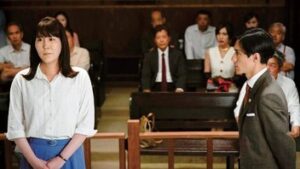
This enraged the police, who would routinely arrest prostitutes in moral clampdowns, only to have to set the trans women prostitutes free without charge. In an attempt to clamp down on trans people, they arrested Dr Akagi, charging him with violation of a Eugenics Protection Law that forbade making anyone sterile. The result was a high-profile, landmark trial, known as the Blue Boy Trial, one of the outcomes of which was to significantly raise trans awareness and visibility in Japan. Blue Boy Trial is a dramatisation of the trial, created and directed very sympathetically by Japanese trans-man director Kasho Iizuka.
 We join the story as Ahko, a bar owner and leader of a group of trans-women prostitutes, gets arrested with a bunch of other girls for solicitation. The trans girls, a super-cool bunch in their sixties garb, know their rights and taunt the arresting officers until they are let go. This police humiliation triggers the crackdown on the trans community and leads to the arrest of Dr Akagi.
Akagi hires a lawyer, Tatu Kano, to represent him. Kano´s initial approach is to declare Akagi´s work vital to help the weak mental health of his trans patients. Kano decides to call various trans patients of Dr Akagi to corroborate this. The first couple of witnesses, Ahko and Mei, are feisty and emotional and totally refute that they are mentally weak, undermining Kano´s defence argument. He decides to come up with another approach.
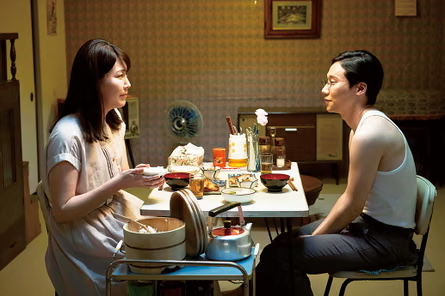
Meanwhile, we meet Sachi, a mild-mannered waitress who’s in a loving relationship and lives a quiet life with her boyfriend Atsuhiko. She’s also a patient of Dr Akagi, and knows many of the trans prostitutes, but her life is a world away from theirs. Kano would like her to testify in the trial, considering her to be a more reliable witness, but she’s very shy and wary of being in the media spotlight. At the same time, she’s grateful for Dr Akagi´s work on her to date and needs him to win so he can complete her surgery. As the trial stumbles along, Sachi needs to make a big decision.
Iizuka has created a sweet gem with Blue Boy Trial. Despite the tough subject matter, what shines through are themes of camaraderie, love, human connection and personal development. Super-chic mid-century sets, cool ´pop´ outfits and a soundtrack of the times take us right into the smoky cigarette-filled world of 1960´s Japan, a colourful authenticity that is also helped by the casting of trans people in all trans character roles. Miyu Nakagawa is excellent as Sochi, as is Izumi Sexi as Ahko, and Ataru Nakamura as Mei, the arch rival of Ahko. Many of the parts are played by people who hadn´t acted before, particularly the prostitutes, who camp and ham it up beautifully with twinkles in their eyes. Iizuka doesn’t shy away from detailing the tough lives trans people faced back then. The plot is fairly linear and straightforward; however, the original story is so interesting that there was no need to play around with it. An important piece of trans history (or herstory) that has been very sensitively brought back to life. 
| Queerguru’s Contributing Editor Ris Fatah is a successful fashion/luxury business consultant (when he can be bothered) who divides and wastes his time between London and Ibiza. He is a lover of all things queer, feminist, and human rights in general. @ris.fatah |
