
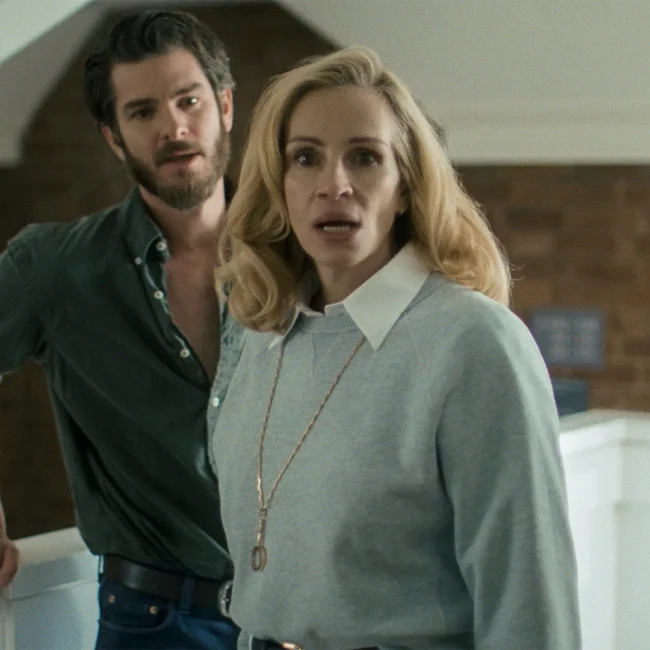
 America’s Ivy League universities have always been a hotbed of intellectual activity and energy. The close concentration of thousands of supremely intelligent people of different incomes, races, generations, and motives can have positive and negative consequences. Yale University philosophy professor Alma (Julia Roberts) experiences this in After The Hunt, a thought-provoking, psychological drama by director-of-the-moment Luca Guadagnino.
Alma has worked hard for decades and dealt with many obstacles to achieve her prestigious Yale professorship. I say dealt with rather than overcome, as it’s clear there is unspoken, unresolved conflict, both with her husband Frederik (Michael Stuhlbarg), her past, and her health. She’s currently competing for tenure with a fellow professor, her handsome colleague Hank (Andrew Garfield). The two are very close, socialising together, and maybe more. She’s also close with her students, inviting them to her home at night to discuss philosophy, including feminist philosophy. One of the students, Maggie (Ayo Edebiri), the queer daughter of billionaire donors to Yale, seems to have developed a crush on Alma. One evening, following a soiree at Alma’s, Maggie accuses Hank of sexual assault after he escorts her home. What follows is a chain of events as Alma tries to work out who to believe, and deal with the disintegration of her close-knit circle as her personal and professional lives get a jolt.
Guadagnino has created a movie of our times. Written by first-time screenwriter Nora Garrett, and set in 2019, After The Hunt is a detailed character study of the different reactions to the assault allegation. Echoes of #MeToo, cancel culture and the current political environment fuse together with an ambiguous, at times uncomfortable, narrative to highlight the imperfection and brutality of humanity. Each character strives to force their own agenda forward, maintaining tough facades, and ignoring the importance of talking and listening to each other. The equal relevance of each character is rare, and gives strength to the battlegrounds on inter-generational expectations, gender, sexuality, wealth and race. All the cast deliver brilliant performances, including Chloe Sevigny as Kim, an eccentric older psychiatrist. I’d have liked to have seen more of her. Roberts, in particular, shines as the cold, austere, blonde professor – who needs to be blonde when you’re a professor? – full of pain, hurt and secrets. Roberts and Edebiri have a great chemistry as they spar over power and their differences, as do Roberts and Garfield. Garfield stays in his lane, almost side-lined by the others, as the in-yer-face beta cis-male heterosexual trying to be alpha. Stuhlbarg is perfect as the side-kick, somewhat ignored husband, often playing up to get attention from the distracted Alma. Trent Reznor and Atticus Ross deliver an interesting soundtrack full of gems, albeit quite loud in places. I guess we are in student-land though. It was shot on location at Yale, an opening sentence of ‘It Happened at Yale’ perhaps inferring a true story. The viewer will question all the characters, as we do those around us. Why are they so flawed? Why don’t they improve? Do we like/dislike them? The outward showing of morality and virtue signalling versus the lack of community action is very relevant. I was left wanting a bit more from the film, but maybe that’s due to the realistic character studies. After The Hunt will provoke discussion with whomever you watch it. Save time for the discussion. It’ll be worth it, although remember the jury can be wrong.
| Queerguru’s Contributing Editor Ris Fatah is a successful fashion/luxury business consultant (when he can be bothered) who divides and wastes his time between London and Ibiza. He is a lover of all things queer, feminist, and human rights in general. @ris.fatah |
