

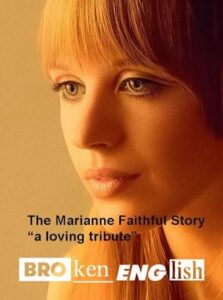
One annoying aspect of arguing is the constant boast that things were better ‘way back when’. In most cases, that simply isn’t true, and our fading memories are too often misleading, bathed in technicolor. However, in this one case, we can categorically say the ‘original’ was the very best.
We are talking about Marianne Faithfull, who was way ahead of the likes of bad girls Amy Winehouse and Britney Spears, and who burst onto the scene in the 1960s and was on everyone’s lips …. and in Mick Jagger’s heart. Faithfull began her career in 1964 after attending a Rolling Stones party, where the band’s manager, Andrew Loog Oldham, discovered her. Her first single was ‘As Tears Go By ‘. and it instantly catapulted to the top of the music charts in the UK and US, and then her popularity was enhanced by roles in films, including I’ll Never Forget What’s Name (1967), The Girl on a Motorcycle (1968), and Hamlet (1969).
During her 1960s musical career, Faithfull was noted for her distinctive melodic, high-register vocals. In the subsequent decade, her voice was altered by severe laryngitis, smoking, and persistent drug abuse, which left her sounding permanently raspy, cracked, and lower in pitch. Some critics praised the new sound as “whisky soaked” and saw it as helping capture the raw emotions in her music.
She inspired several Stones songs and appears on The Beatles’ ‘Yellow Submarine’. In 1969, she wrote the lyrics for the infamous ‘Sister Morphine’, which seemed to be about herself, leading to her being reviled. But when The Stones included it on ‘Sticky Fingers’ a short time later, with credits for Jagger and Richards, no one objected. After a legal battle of more than twenty years, Marianne Faithfull received her share of the rights.
Faithfull’s life spiraled out of control in the 1970s in an unimaginable way, and her popularity was overshadowed by personal problems when she became anorexic, homeless, and addicted to heroin.
But she made a musical comeback in 1979 with her critically acclaimed seventh studio album, Broken English. The album was a commercial success and marked a resurgence of her musical career. Broken English earned Faithfull a Grammy nomination for Best Female Rock Vocal Performance and is regarded as her “definitive recording”. Her relationship with Jagger was over, but by then, like others of my generation, I had totally fallen for Faithfull
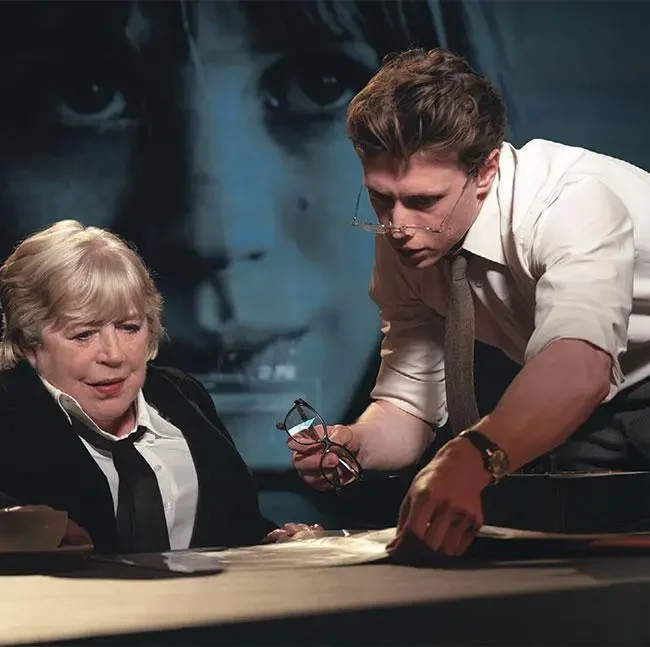
This new documentary. also called Broken English, made by an extremely creative pair of filmmakers Iain Forsyth and Jane Pollard, relates her life story through the fictitious “Ministry of Not Forgetting,” an institution dedicated to examining truths and myths and the porous line between the two. (The too fabulous) Tilda Swinton presides over it as a sharp-suited bureaucrat. Faithfull is the project and Swinton its exacting overseer. “We need to take a proper look at Marianne’s role as a destabilizing influence,” she says by way of moving the action forward. Faithfull is the project and Swinton its exacting overseer. “We need to take a proper look at Marianne’s role as a destabilizing influence,” she says by way of moving the action forward.
We see a very happy and relaxed Faithfull ….. a true survivor ….. enjoying the whole process of wandering back across her past lives. But her health has been ravaged by emphysema and Covid and she’s vague on some details and unwilling to revisit some others, and has to occasionally pause to insert an oxygen tube.
Faithfull died last year at 78, just as the film was released, so in a way Broken English catches the legend’s last glow, just before the light went out for good. She will be sorely missed, and I feel so extremely lucky to have walked the earth at the same time she was here
|
Broken English is currently available to rent or stream on Amazon Video and BFI Player. in the UK BUT at present unavailable to stream in the US: watch this space
|
|
ROGER WALKER-DACK. Editor-in-Chief Member of G.A.L.E.C.A. (Gay & Lesbian Entertainment Critics Association), NLGJA The Association of LGBT Journalists), and The Online Film Critics Society. Ex-Contributing Editor, The Gay Uk & Contributor, Edge Media; former CEO and Menswear Designer of Roger Dack Ltd |

Leave a Reply