

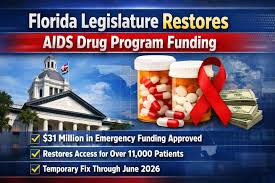
I cannot remember a single instance when Queerguru has ever had anything positive to say about Florida Governor Ron DeSantis. Until now, that is. This week, he signed a bill ensuring that some Floridians living with HIV can access three more months of life-saving antiretroviral medications through the state’s ADAP program.
ADAP, the AIDS Drug Assistance Program, is a state-level initiative that helps low-income and uninsured people living with HIV access medications that would otherwise be prohibitively expensive. As of 2025, Florida ranks third in the nation for HIV diagnoses, with about 4,290 new cases annually — accounting for roughly 11% of all diagnoses nationwide and far surpassing fourth-place Georgia, which reports 2,511 new cases per year.
In response to an alleged $120 million budget shortfall, Florida introduced an emergency rule earlier this month lowering income eligibility to those earning less than 130% of the federal poverty level, or about $20,500 annually, as previously reported by POZ magazine.
The change threatened to leave between 10,000 and 16,000 Floridians without access to medications needed to achieve viral suppression, or “undetectable” status, which helps prolong life and prevent transmission.
A bipartisan group of Florida lawmakers crafted and passed an emergency stopgap funding bill that cleared both chambers unanimously and was signed into law by DeSantis on March 24.
The stopgap measure provides nearly $31 million to keep the program running through June 30, the end of fiscal year 2026. It also restores the income threshold to 400% of the federal poverty level, allowing enrollees earning less than $64,000 annually to access HIV medications during that period. An estimated 12,000 people will continue receiving coverage through the end of June.
HIV advocates and pro-LGBTQ groups praised the temporary fix as much-needed relief for low-income Floridians.
“For ten weeks, 12,000 Floridians living with HIV did not know if they could fill their next prescription,” said Esteban Wood, director of advocacy and legislative affairs at AIDS Healthcare Foundation. “Today, they can.”

Leave a Reply